
Overview
This review evaluates the 2026 Kaiser findings on adolescent cannabis psychiatric risk and population-level impact. A 2026 cohort study published in JAMA Health Forum examined whether adolescent cannabis use was associated with increased risk of developing psychotic, bipolar, depressive, and anxiety disorders during adolescence and young adulthood.
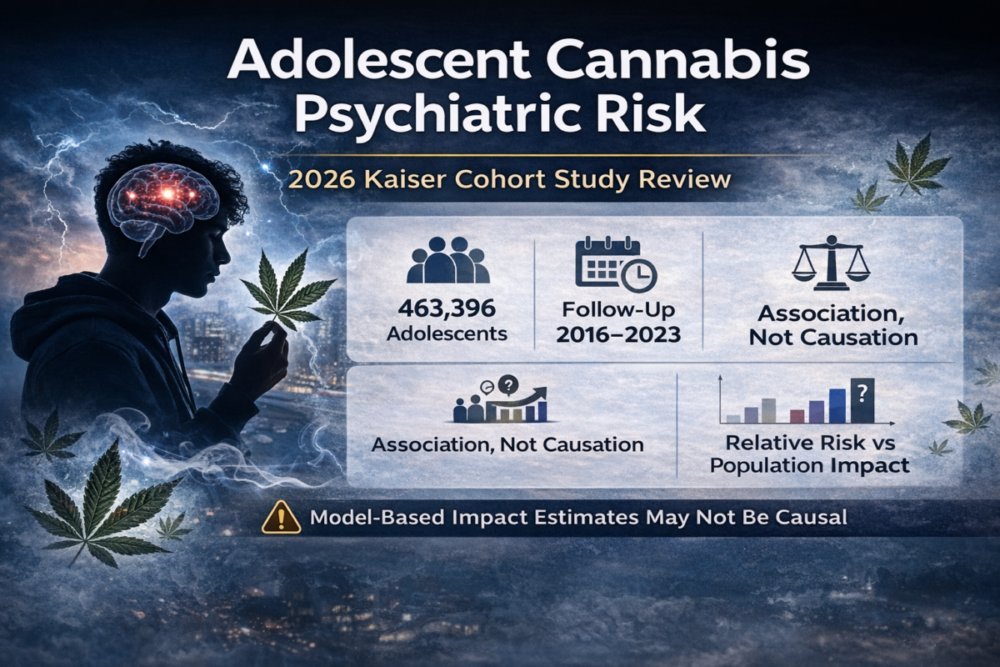
The study, conducted within Kaiser Permanente Northern California, followed 463,396 adolescents aged 13 to 17 years who were screened for past-year cannabis use between 2016 and 2023.
This article reviews the study design, reported findings, methodological structure, and population-level impact estimates.
Study Design and Population
The cohort included adolescents who completed a universal confidential screening questionnaire during routine pediatric care.
Exposure was defined as:
Self-reported past-year cannabis use (yes/no).
Key characteristics:
- Entry age: 13–17 years
- Follow-up: Through age 25 or December 31, 2023
- Outcomes: Clinician-diagnosed psychotic, bipolar, depressive, and anxiety disorders
- Method: Cox proportional hazards regression
- Covariates: Sex, race/ethnicity, neighborhood deprivation index, insurance type, alcohol use, other substance use
Exposure was modeled as time-varying.
Adolescent Cannabis Psychiatric Risk Findings
The study reported adjusted hazard ratios (AHR):
- Psychotic disorders: 2.19
- Bipolar disorder: 2.01
- Depressive disorder: 1.34
- Anxiety disorder: 1.24
These values indicate increased relative risk among adolescents reporting past-year cannabis use compared to non-users, after statistical adjustment.
The strongest associations were observed for psychotic and bipolar disorders.
For depressive and anxiety disorders, associations decreased with age and were not statistically significant in the 21–25 age subgroup.
Exposure Prevalence
At baseline:
5.7% of adolescents reported past-year cannabis use.
Because exposure was time-varying, this baseline percentage does not fully represent cumulative exposure across follow-up.
Attempted Independent Recalculation of Population Impact
An independent recalculation of Population Attributable Fraction (PAF) was attempted using the most direct incidence-based method.
That method requires:
- Cases among exposed
- Person-years among exposed
- Cases among unexposed
- Person-years among unexposed
The published article and supplementary materials did not provide exposure-stratified case counts or person-time breakdowns.
Therefore:
An incidence-based PAF calculation could not be performed using publicly available data.
Model-Based Population Impact Estimates
Using published baseline exposure prevalence (5.7%) and adjusted hazard ratios (assuming HR ≈ RR), estimated attributable fractions under model-based assumptions were approximately:
- Psychotic disorders: ~6%
- Bipolar disorder: ~5%
- Depressive disorder: ~2%
- Anxiety disorder: ~1%
These represent estimated proportions of total cases potentially associated with adolescent cannabis use if the association is causal and assumptions hold.
These estimates are sensitive to exposure prevalence and modeling assumptions.
For readers unfamiliar with Population Attributable Fraction (PAF), see our explainer: What Is Population Attributable Fraction?
Relative Risk vs Population Impact
A hazard ratio of 2.19 does not mean that most psychotic disorders are caused by cannabis.
Relative risk describes increased likelihood among exposed individuals.
Population Attributable Fraction estimates the share of total cases linked to exposure in the population.
When exposure prevalence is modest, total population impact remains proportionally limited even if relative risk is elevated.
Sensitivity Considerations
Several structural factors influence interpretation:
- Exposure was self-reported.
- Frequency, potency, and mode of use were not measured.
- Residual confounding cannot be ruled out.
- Reverse causation cannot be excluded.
- The population reflects Kaiser Permanente Northern California members and may not generalize nationally.
The study design establishes association, not causation.
Strengths of the Study
- Large sample size (463,396 adolescents)
- Universal screening during routine care
- Longitudinal follow-up into early adulthood
- Multiple psychiatric outcomes examined
- Time-varying exposure modeling
- Sensitivity analyses performed
Limitations
- Observational design
- No exposure dose-response measurement
- No exposure-stratified incidence tables published
- Possible underreporting of cannabis use
- Potential unmeasured confounding factors
Because exposure-stratified incidence data were not publicly available, strict incidence-based recalculation of population impact was not possible.
Interpretation
The study found statistically significant associations between adolescent cannabis use and later psychiatric diagnoses, particularly psychotic and bipolar disorders.
Model-based estimates suggest that, under stated assumptions, the proportion of total cases attributable to cannabis exposure appears to be in the single-digit percentage range.
These findings reflect relative increases in risk among exposed adolescents and modest population-level impact under baseline prevalence conditions.
Interpretation depends on:
- Assumed causality
- Exposure prevalence stability
- Model validity
- Absence of major unmeasured confounding
Conclusion
The 2026 Kaiser cohort study reports an association between adolescent cannabis use and increased risk of multiple psychiatric disorders.
The strongest relative associations were observed for psychotic and bipolar disorders.
Independent recalculation confirms that strict incidence-based population impact estimation cannot be performed from published tables. Model-based estimates suggest single-digit attributable fractions under baseline exposure prevalence.
As with all observational research, findings should be interpreted within the context of methodological constraints and causal uncertainty.