
? Section 1: Global Perspectives on Hemp — Diverging Paths
The U.S. Influence and Global Reactions
Why was hemp made illegal? The answer isn’t just buried in outdated laws — it’s wrapped in fear, misinformation, and profit. Powerful industries and politicians pushed a hidden agenda that criminalized one of Earth’s oldest crops. This article exposes those forces and explores why the truth is finally coming to light.
However, global responses varied:
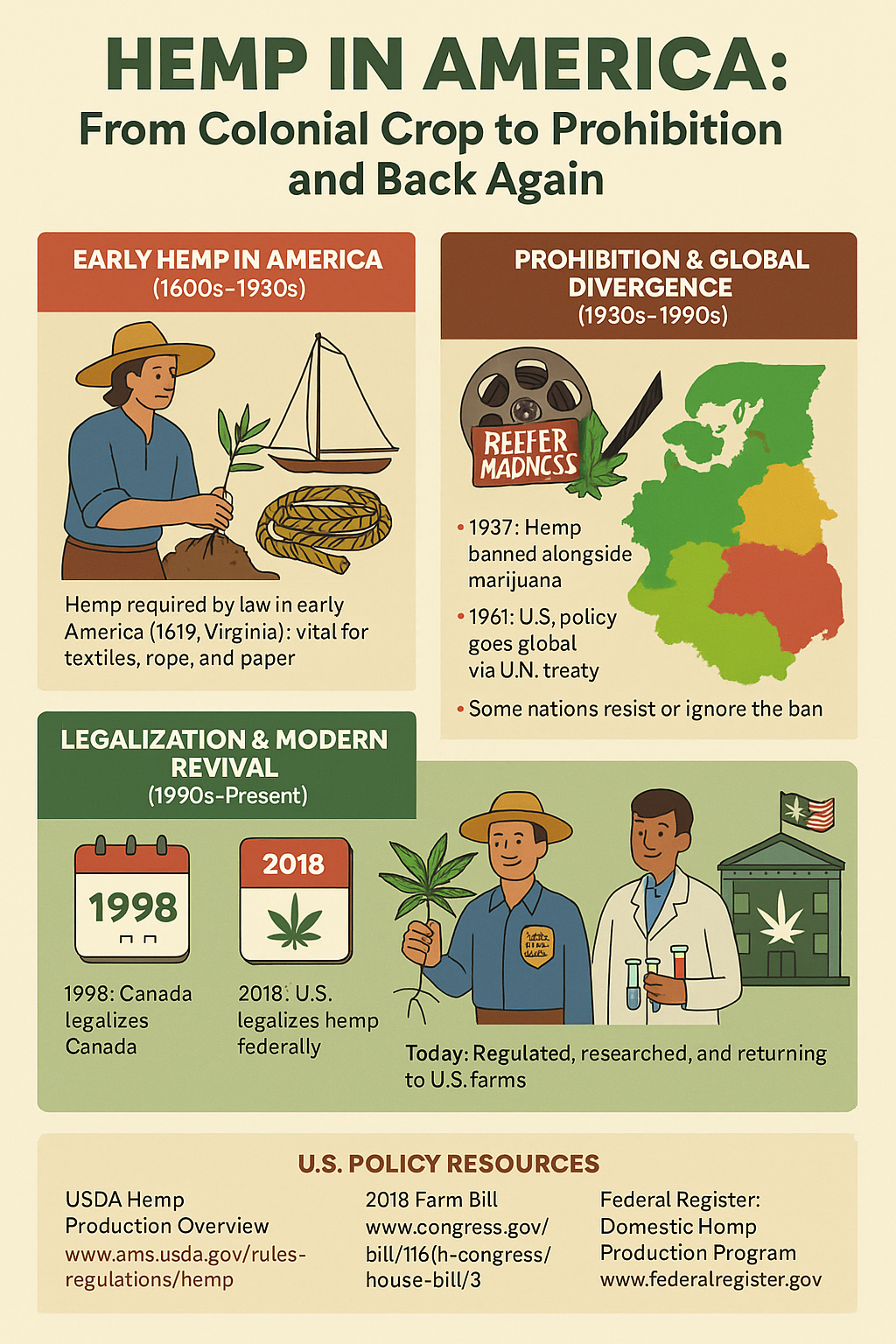
- Adopters of U.S. Policy: Countries like Canada and several Western European nations mirrored U.S. drug laws, leading to restrictive measures on hemp cultivation.
- Independent Approaches: China never fully prohibited hemp cultivation. It has become the world’s largest producer. China accounts for over 70% of global output. India preserved traditional uses of cannabis and hemp through cultural and religious exemptions.Wikipedia
Canada’s Legalization of Hemp
Canada legalized the commercial cultivation of industrial hemp in 1998. This was done through the Industrial Hemp Regulations under the Controlled Drugs and Substances Act. This regulatory framework established a licensing system for the controlled production and processing of industrial hemp.
? Section 2: U.S. Regulatory Challenges and Hemp’s Legal Status
The Controlled Substances Act and Hemp
The Controlled Substances Act (CSA) of 1970 classified cannabis as a Schedule I substance. This classification indicates a high potential for abuse. It also implies no accepted medical use. Nonetheless, the CSA explicitly excluded certain parts of the cannabis plant from this definition:DEA
“The term ‘marijuana’ does not include the mature stalks of such plant. It does not include fiber produced from such stalks, oil or cake made from the seeds of such plant. It also does not include any other compound, manufacture, salt, or derivative. This includes any mixture or preparation of such mature stalks (except the resin extracted from them), fiber, oil, or cake. It also excludes the sterilized seed of such plant which is incapable of germination.” Legal Information Institute
Despite this exclusion, the Drug Enforcement Administration (DEA) maintained a restrictive stance on hemp. In 2001, the DEA issued rules attempting to ban hemp food products, citing trace amounts of THC. This led to legal challenges, and in 2004, the Ninth Circuit Court ruled in Hemp Industries Association v. DEA that the DEA had overstepped its authority. The court stated that naturally occurring THC in non-psychoactive hemp products was not subject to DEA regulation.
Research and Cultivation Barriers
Even after the court ruling, hemp cultivation in the U.S. faced significant hurdles:
- Licensing Requirements: Researchers and farmers needed special federal licenses for hemp cultivation.
- DEA Oversight: Strict regulations required DEA-cleared storage and monitoring of hemp crops.
- Seed Importation Challenges: Importing hemp seeds was treated with the same scrutiny as controlled substances.
These barriers hindered research and development, leaving the U.S. lagging behind countries like Canada and China in hemp industry advancements.
Hemp Policy: Past vs. Present
| Then (1970s–1990s) | Now (2020s) |
|---|---|
| Cannabis = Schedule I felony | Legal in many U.S. states |
| Hemp = banned by association | Legal federally since 2018 (2018 Farm Bill) |
| Medical experts ignored | Cannabis research expanding |
| “Just Say No” and zero-tolerance | Expungement and social equity reform |
| Hemp erased from U.S. policy | Re-entering agriculture, media, and markets |
U.S. Hemp Policy Today: Official Resources
For those interested in the current legal landscape and compliance requirements, here are essential U.S. government resources:
- USDA Hemp Production Overview
The main USDA portal for federal hemp production regulations, guidance, and updates. - USDA Hemp Rulemaking Documents
Access the Final Rule, Interim Final Rule, and official compliance guidelines. - USDA Hemp Production Program Q&A
Answers common questions about licensing, testing, and state/tribal plans. - Federal Regulations for Hemp Production (7 CFR Part 990)
The official federal regulations for hemp production in the U.S. - USDA Guidance for Hemp Growers
Information on licensing, reporting, and USDA support for hemp farmers. - Federal Register: Establishment of a Domestic Hemp Production Program
The official publication of the rule establishing the national hemp program.
Conclusion
The story of hemp prohibition is one of missed opportunities, global divergence, and eventual revival. As the world moves ahead, the U.S. is finally catching up—reclaiming its place in the global hemp industry after decades of delay. For those navigating today’s legal landscape, the USDA and federal government offer official resources. These resources give the roadway for a new era of American hemp.
? Join the Conversation
The criminalization of hemp wasn’t an accident — it was a strategy. Do you believe the truth is finally surfacing? Share your thoughts below or explore the next part of the “They Tried to Kill It” series.