
Executive Summary
Why modern cannabis feels stronger than it used to is a question many consumers ask when comparing today’s products with cannabis from previous decades.
Many people who consumed cannabis years ago often say the same thing when they encounter modern products:
“This feels much stronger than I remember.”Many people who consumed cannabis decades ago often say the same thing when they encounter modern products:
“This feels much stronger than I remember.”
In many cases, that perception is supported by measurable changes in cannabis potency. Over the past several decades, average THC concentrations have increased significantly, cultivation methods have evolved, new product types have emerged, and the balance between major cannabinoids has shifted.
However, potency alone does not tell the entire story. The way cannabis is grown, processed, and consumed today also influences the overall experience.
Understanding these changes helps explain why modern cannabis may feel different from cannabis used in previous generations.
Table of Contents
Is Cannabis Actually Stronger Today?
Current evidence suggests that cannabis potency has increased substantially since the early 1990s.
Researchers, government testing programs, and historical analyses consistently show that average THC concentrations found in cannabis products today are significantly higher than those commonly reported several decades ago.
While individual products varied throughout history, the overall trend has been toward higher THC concentrations and the availability of more potent product forms.
This does not mean every modern cannabis product is stronger than every historical product. Potent cannabis existed in earlier eras. However, higher-potency products are now far more common and widely available than they once were.
For a broader overview of cannabis science and health research, see Cannabis and Human Health.
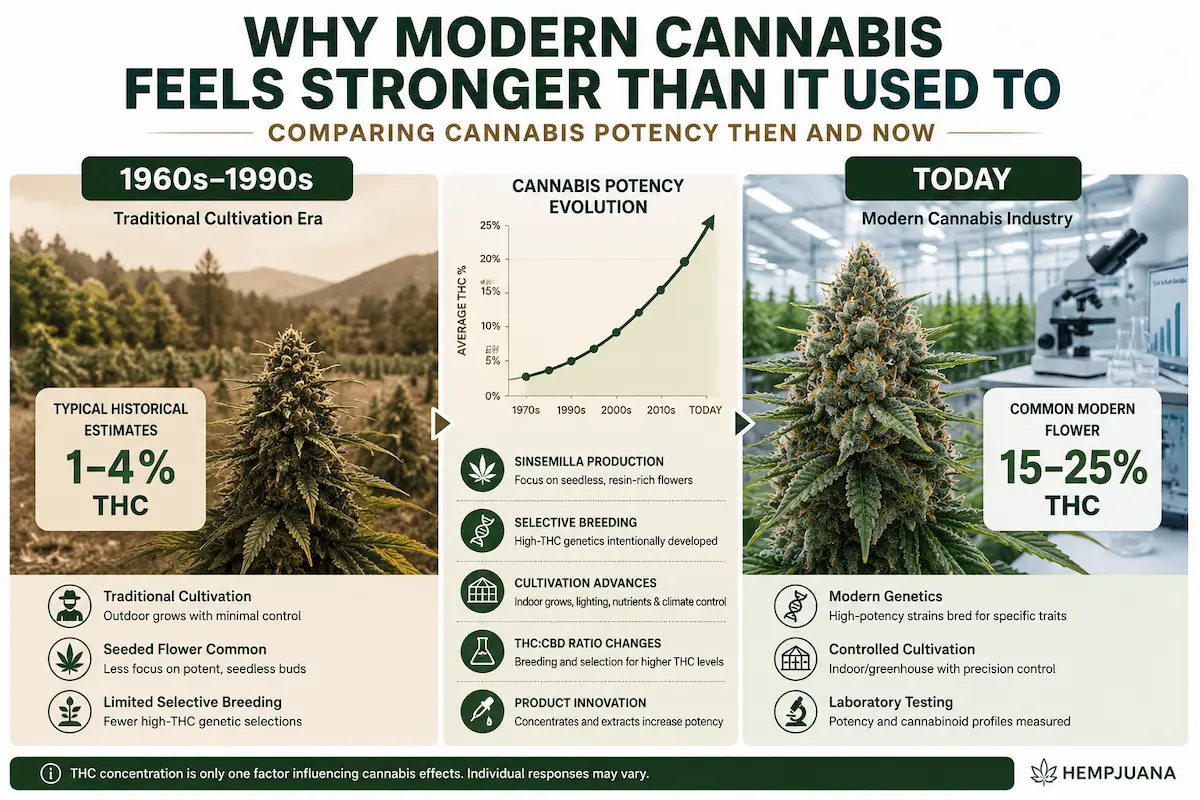
THC Levels: Then vs Now
Important Historical Note
Cannabis potency estimates from the 1960s through the early 1990s should be viewed as approximations. Testing methods, sample collection practices, and reporting standards were often less consistent than those used today. Historical potency figures help illustrate long-term trends but should not be interpreted as exact measurements.
Readers interested in long-term potency monitoring can explore research maintained by the National Institute on Drug Abuse (NIDA).
1960s
- Often estimated around 1–3% THC
- Limited laboratory testing available
1970s
- Common estimates generally ranged between 2–4% THC
- Potency varied significantly by region and source
1980s
- Many samples tested between 3–5% THC
- Higher-potency products began appearing more frequently
Early 1990s
- Average THC concentrations were generally below 4%
- Federal testing programs documented relatively low average potency compared to modern products
Modern Potency Estimates
Modern Cannabis Flower
- Commonly ranges between approximately 15–25% THC
- Some products exceed 30% THC
Cannabis Concentrates
- Commonly range from 60–90%+ THC
- Include products such as waxes, shatter, oils, and distillates
The result is a marketplace where consumers can access products with THC concentrations that were uncommon several decades ago.
The Rise of Sinsemilla and Modern Breeding
One major reason for increasing potency is the widespread adoption of sinsemilla cultivation.
The word sinsemilla comes from Spanish and means “without seeds.”
Modern cannabis growers often cultivate seedless cannabis, known as sinsemilla, by preventing pollen from male plants from reaching female plants. Without pollination, the plant does not produce seeds and instead continues developing resin-rich flowers that can contain higher concentrations of cannabinoids such as THC.
Historically, many cannabis crops contained both male and female plants. Pollination often resulted in seed production, which diverted some of the plant’s energy toward reproduction.
Modern cultivation practices generally focus on producing seedless flowers, which are often preferred in commercial cannabis markets.
In addition to sinsemilla cultivation, breeders have spent decades selectively developing plants with desired traits, including cannabinoid production, aroma profiles, yield, and consistency.
Together, selective breeding and seedless cultivation contributed to the availability of higher-potency cannabis products.
Readers interested in general cannabis research may also find the NIDA Cannabis Overview helpful.
The Decline of CBD in Modern Cannabis
Another change involves the relationship between THC and CBD.
Historically, many cannabis varieties contained a broader balance of cannabinoids. While THC was still responsible for the primary intoxicating effects, CBD was often present in more noticeable amounts.
Over time, commercial breeding frequently prioritized higher THC concentrations.
As a result, many modern cannabis products contain significantly higher THC-to-CBD ratios than products commonly found decades ago.
Researchers continue studying how cannabinoids interact and how varying cannabinoid profiles may influence user experiences.
Because many modern products contain relatively little CBD compared to THC, some consumers report that contemporary cannabis feels different from cannabis they remember from earlier decades.
The precise reasons for these perceptions remain an active area of research.
For a deeper explanation of cannabinoid differences, see What Is CBD and How Is It Different From THC?.
Readers interested in cannabinoid science can also explore educational materials available through the National Institutes of Health (NIH).
Potency vs Dose: Understanding the Difference
One of the most important concepts in cannabis education is that THC percentage and THC dose are not the same thing.
Potency refers to the concentration of THC within a product.
Dose refers to the total amount of THC consumed.
For example, a small amount of a high-potency product may deliver less THC than a larger amount of a lower-potency product.
Several factors influence THC exposure:
- THC concentration
- Amount consumed
- Frequency of use
- Product type
- Individual tolerance
- Consumption method
Because of these variables, two products with different potency percentages can sometimes produce similar overall THC exposure depending on how they are used.
Understanding dose rather than focusing solely on percentage can help consumers better understand product strength.
Additional public health information can be found through the Centers for Disease Control and Prevention (CDC).
How Delivery Methods Changed Cannabis Use
The way cannabis is consumed has changed significantly over time.
Smoking
Smoking remains one of the most common methods of cannabis use.
Effects typically occur relatively quickly because cannabinoids enter the bloodstream through the lungs.
Vaping
Vaporization devices have become increasingly common in modern cannabis markets.
These products can deliver cannabinoids efficiently while offering a different user experience than traditional smoking.
Edibles
Edible products process differently within the body.
Because effects may take longer to appear, some consumers accidentally consume more than intended before the initial dose fully takes effect.
Concentrates
Concentrates represent one of the largest changes in the cannabis landscape.
Products containing 60–90%+ THC can deliver substantially higher concentrations than traditional cannabis flower.
For this reason, concentrates generally require greater dose awareness than many flower products.
The expansion of these delivery methods helps explain why modern cannabis experiences may feel different from those reported by previous generations. Readers interested in the broader relationship between cannabis consumption and human health can explore Cannabis and Human Health
Do High-THC Products Increase Risks?
Higher-potency products can increase the importance of dose awareness.
Consuming more THC than intended may increase the likelihood of unwanted effects such as:
- Temporary anxiety
- Dizziness
- Impairment
- Discomfort
- Confusion
These effects are often associated with overconsumption rather than potency alone.
Research suggests that frequent use of high-potency cannabis may be associated with increased psychosis risk in some vulnerable individuals, but the relationship is complex and not fully explained by THC exposure alone.
Researchers continue studying how genetics, age, frequency of use, mental health history, environmental factors, and cannabinoid composition may influence outcomes.
Current evidence does not support simple cause-and-effect conclusions for all individuals.
A balanced understanding of potency, dose, and personal factors remains important when discussing cannabis-related risks.
Researchers have expressed particular interest in adolescents and individuals with certain mental health risk factors. Readers interested in current research can explore Adolescent Cannabis Psychiatric Risk: 2026 Kaiser Review.
For readers interested in broader mental health research, the National Institute of Mental Health (NIMH) provides additional educational resources.
Why Modern Cannabis Feels Different
Several changes have occurred simultaneously over the past few decades:
- Average THC concentrations increased
- Seedless sinsemilla cultivation became widespread
- Selective breeding emphasized potency
- THC-to-CBD ratios shifted
- Concentrates entered the market
- New delivery methods expanded access
- Product consistency improved
Because these developments occurred together, many consumers perceive modern cannabis as stronger than cannabis they encountered years ago.
In many cases, that perception reflects measurable changes in potency. In other cases, differences in product type, dose, cannabinoid ratios, and delivery methods may also contribute to the experience.
Key Takeaways
Modern cannabis is often stronger than cannabis commonly available in previous decades.
Average THC concentrations have increased substantially since the early 1990s, while concentrates and other high-potency products have become widely available.
The widespread use of sinsemilla cultivation, selective breeding, and changing THC-to-CBD ratios contributed to these developments.
At the same time, potency alone does not determine the user experience. Dose, product type, consumption method, and individual factors all play important roles.
Understanding these distinctions helps explain why modern cannabis may feel very different from cannabis used by previous generations.
For a broader overview of cannabis science and health research, visit Cannabis and Human Health.
Editorial Note
This article is provided for informational and educational purposes only. It is based on publicly available research and historical information available at the time of writing. It should not be considered medical, legal, or professional advice. Readers should conduct their own research and consult qualified professionals when making health, legal, or personal decisions.
Version: v1.0
Based on verified scientific, historical, and educational sources current as of June 2026.
Concentrates
Concentrates represent one of the largest changes in the cannabis landscape.
Products containing 60–90%+ THC can deliver substantially higher concentrations than traditional cannabis flower.
For this reason, concentrates generally require greater dose awareness than many flower products.
The expansion of these delivery methods helps explain why modern cannabis experiences may feel different from those reported by previous generations.
Do High-THC Products Increase Risks?
Higher-potency products can increase the importance of dose awareness.
Consuming more THC than intended may increase the likelihood of unwanted effects such as:
- Temporary anxiety
- Dizziness
- Impairment
- Discomfort
- Confusion
These effects are often associated with overconsumption rather than potency alone.
Research suggests that frequent use of high-potency cannabis may be associated with increased psychosis risk in some vulnerable individuals, but the relationship is complex and not fully explained by THC exposure alone.
Researchers continue studying how genetics, age, frequency of use, mental health history, environmental factors, and cannabinoid composition may influence outcomes.
Current evidence does not support simple cause-and-effect conclusions for all individuals.
A balanced understanding of potency, dose, and personal factors remains important when discussing cannabis-related risks.
Researchers have expressed particular interest in adolescents and individuals with certain mental health risk factors. Readers interested in current research can explore our review of adolescent cannabis psychiatric risk and the 2026 Kaiser cohort study.
For readers interested in broader mental health research, the National Institute of Mental Health (NIMH) maintains educational resources covering psychiatric research and mental health conditions.
Why Modern Cannabis Feels Different
Several changes have occurred simultaneously over the past few decades:
- Average THC concentrations increased
- Seedless sinsemilla cultivation became widespread
- Selective breeding emphasized potency
- THC-to-CBD ratios shifted
- Concentrates entered the market
- New delivery methods expanded access
- Product consistency improved
Because these developments occurred together, many consumers perceive modern cannabis as stronger than cannabis they encountered years ago.
In many cases, that perception reflects measurable changes in potency. In other cases, differences in product type, dose, cannabinoid ratios, and delivery methods may also contribute to the experience.
Key Takeaways
Modern cannabis is often stronger than cannabis commonly available in previous decades.
Average THC concentrations have increased substantially since the early 1990s, while concentrates and other high-potency products have become widely available.
The widespread use of sinsemilla cultivation, selective breeding, and changing THC-to-CBD ratios contributed to these developments.
At the same time, potency alone does not determine the user experience. Dose, product type, consumption method, and individual factors all play important roles.
Understanding these distinctions helps explain why modern cannabis may feel very different from cannabis used by previous generations.
For readers seeking a broader understanding of cannabis science and health research, Cannabis and Human Health serves as the parent educational resource for this topic.
Editorial Note
This article is provided for informational and educational purposes only. It is based on publicly available research and historical information available at the time of writing. It should not be considered medical, legal, or professional advice. Readers should conduct their own research and consult qualified professionals when making health, legal, or personal decisions.
Version: v1.0
Based on verified scientific, historical, and educational sources current as of June 2026.