
Introduction
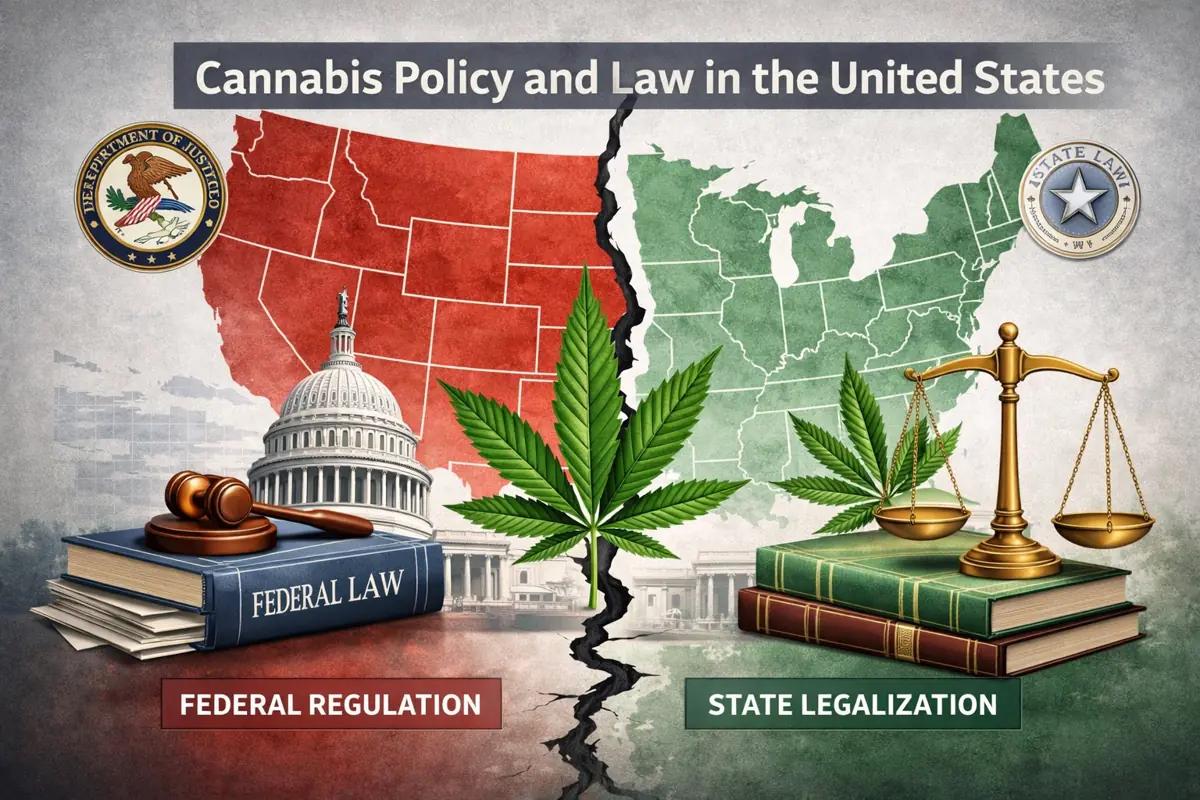
Cannabis policy and law in the United States is often misunderstood because federal and state systems operate at the same time. While many states have legalized cannabis for medical or adult use, federal law continues to regulate marijuana through national drug control statutes. This overlapping legal structure creates confusion about what is permitted under federal law and how federal agencies approach cannabis-related activities.
Understanding US federal cannabis law requires examining several components: the Controlled Substances Act, federal hemp legislation, federal tax rules, financial compliance requirements, and ongoing regulatory debates about marijuana scheduling. These areas together form the current federal framework governing cannabis.
Overview of Federal Cannabis Law
The core of US federal cannabis law is the Controlled Substances Act (CSA), which establishes federal drug schedules and defines regulated substances. Under the CSA, marijuana is defined as a controlled substance, while hemp is excluded from that definition when it meets specific statutory requirements.
Marijuana and tetrahydrocannabinols are currently classified as Schedule I controlled substances under federal law. Schedule I substances are placed in the category that federal law treats as having high abuse potential and no accepted medical use within the statutory framework of the CSA.
Although many states have adopted medical or adult-use cannabis laws, federal statutes remain applicable nationwide. This federal–state difference is one of the main reasons federal cannabis policy remains a complex legal topic.
The Controlled Substances Act and Marijuana Scheduling
The Controlled Substances Act provides the legal framework for how drugs are scheduled and regulated under federal law. The statute defines marijuana as a controlled substance while excluding hemp that meets federal statutory criteria.
Under federal law, marijuana and tetrahydrocannabinols remain in Schedule I, meaning they are subject to the strictest federal controls.
Authority to change the scheduling of a substance under the CSA belongs to the Attorney General of the United States. In practice, this authority is administered by the Drug Enforcement Administration (DEA), which conducts the scheduling process with scientific and medical review from the U.S. Department of Health and Human Services (HHS).
This administrative framework allows substances to be moved between schedules if federal agencies determine that statutory criteria are met.
Hemp vs Marijuana Under Federal Law
Understanding the difference between hemp and marijuana is essential to how federal law defines cannabis.
Federal law distinguishes hemp from marijuana using a statutory definition created by Congress.
The Agriculture Improvement Act of 2018, commonly called the 2018 Farm Bill, removed hemp from the federal definition of marijuana when the plant contains no more than 0.3 percent delta-9 tetrahydrocannabinol (THC) on a dry-weight basis. Hemp that meets this threshold is not treated as marijuana under the Controlled Substances Act.
Congress later enacted Public Law 119-37, which modifies aspects of the federal hemp definition. These changes are scheduled to take effect November 12, 2026.
Clarification: Hemp and Cannabinoids
Misconception
Hemp legalization makes all cannabinoids legal.
Clarification
Although hemp is excluded from the marijuana definition when it meets federal requirements, cannabinoid products may still fall under regulatory authority from federal agencies. For example, the Food and Drug Administration regulates certain products containing cannabinoids.
DEA Rescheduling Debate
This ongoing process reflects how cannabis policy and law in the United States continues to evolve at the federal level.
In 2024, the Drug Enforcement Administration proposed moving marijuana from Schedule I to Schedule III under the Controlled Substances Act. The proposal initiated a formal administrative process that includes hearings and regulatory review.
However, administrative hearings related to the rescheduling proposal were postponed and remain unresolved.
Clarification: Schedule III and Federal Legality
Misconception
If marijuana moves to Schedule III, cannabis becomes federally legal.
Clarification
Rescheduling changes how a substance is classified under the Controlled Substances Act. It does not automatically legalize recreational cannabis at the federal level. For historical context, federal cannabis policy developed alongside earlier history of hemp in the United States
.
FDA Regulation of CBD
The Food and Drug Administration (FDA) regulates products that contain cannabidiol (CBD) when those products fall under the agency’s jurisdiction.
The FDA has stated that CBD cannot currently be marketed as a dietary supplement under federal law. This position is based on the existing regulatory framework governing food, drugs, and dietary supplements.
As a result, CBD products may be subject to FDA enforcement if they are marketed in ways that conflict with federal regulatory requirements.
Cannabis Banking and Financial Compliance
Financial institutions that provide services to cannabis-related businesses must comply with federal financial regulations.
The Financial Crimes Enforcement Network (FinCEN) requires financial institutions to file suspicious activity reports for transactions involving cannabis-related businesses. This reporting framework was designed to address compliance obligations under federal anti-money-laundering laws.
Because cannabis remains a federally controlled substance, financial institutions often implement enhanced compliance procedures when dealing with cannabis-related transactions.
Federal Cannabis Taxation and IRS 280E
Federal tax law imposes unique restrictions on businesses involved with federally controlled substances.
Under Internal Revenue Code §280E, businesses trafficking in Schedule I or Schedule II controlled substances cannot deduct ordinary business expenses from their federal taxable income.
Because marijuana remains a Schedule I substance under federal law, cannabis businesses may face significant limitations on the deductions they can claim for federal tax purposes.
State Legalization vs Federal Authority
State cannabis legalization has expanded across the United States, but federal law continues to apply nationwide.
In Gonzales v. Raich (2005), the U.S. Supreme Court ruled that Congress has authority under the Commerce Clause to enforce federal cannabis prohibition even in states that allow medical marijuana.
Federal courts are also considering additional constitutional questions related to cannabis markets. Some courts have disagreed on whether the Dormant Commerce Clause applies to state cannabis regulatory systems. This issue remains unresolved in federal litigation.
Future of Federal Cannabis Policy
Several federal cannabis policy issues remain under active consideration or development.
The DEA rescheduling proposal could potentially change marijuana’s classification within the Controlled Substances Act if the administrative process is completed.
Separately, statutory changes enacted through Public Law 119-37 will modify aspects of the federal hemp definition beginning in November 2026.
At the same time, federal courts continue to address constitutional questions related to state cannabis markets, including disputes involving the Dormant Commerce Clause.
These developments illustrate that federal cannabis policy continues to evolve through legislation, regulatory processes, and judicial decisions.
Version: v1.0
Based on verified statutory and regulatory sources current as of March 2026.