
Executive Summary
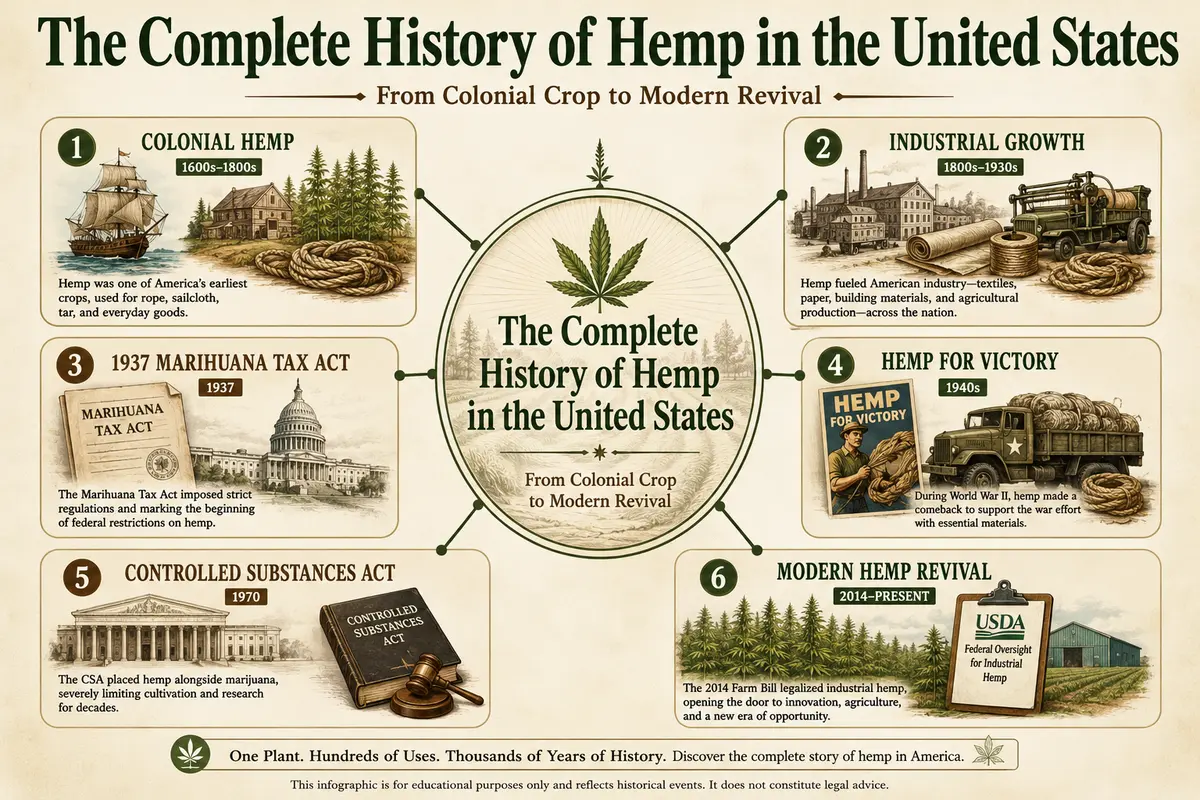
The history of hemp in the United States reflects a series of distinct legal and economic phases rather than a single continuous policy.Hemp began as an agricultural fiber crop in the colonial period, expanded during early industrial development, declined in the late 1800s, and became subject to federal regulation under the Marihuana Tax Act of 1937. During World War II, hemp production temporarily increased under federal promotion. The Controlled Substances Act of 1970 later classified cannabis broadly, placing hemp under the same regulatory framework. Limited reintroduction occurred through research programs authorized by the 2014 Farm Bill, followed by full federal legalization of hemp as an agricultural commodity under the 2018 Farm Bill. Today, hemp operates under a structured regulatory system involving federal and state oversight.
Table of Contents
Colonial and Early American Hemp
Hemp was cultivated in early American colonies primarily as a fiber crop used for rope, sailcloth, and textiles. Its value was tied to maritime and agricultural needs rather than chemical or medicinal uses.
In regions such as Virginia during the early 1600s, hemp production was encouraged as part of broader agricultural development. References from this period indicate that colonial authorities promoted hemp cultivation due to its economic utility, particularly for naval supplies.
Hemp functioned as a practical raw material within a developing agrarian economy and was integrated into early domestic production systems.
1800s Expansion and Decline
During the 19th century, hemp production expanded alongside industrial growth, particularly in regions suited for large-scale agriculture. Demand for durable natural fibers supported its role in rope-making, textiles, and other industrial applications.
However, hemp production declined toward the late 1800s due to multiple converging factors:
- Increased cotton production in the southern United States
- Growth of imported fibers such as jute
- Industrial changes reducing reliance on traditional rope and sail materials
This decline was gradual and driven by economic competition and shifting industrial needs rather than a single legal change.
What the 1937 Marihuana Tax Act Actually Did
The Marihuana Tax Act of 1937 imposed a federal tax and registration framework on cannabis-related activities, including hemp.
Key elements of the law included:
- Mandatory registration with federal authorities
- Tax requirements on the transfer and production of cannabis
- A broad statutory definition of “marihuana” that encompassed multiple parts of the cannabis plant
While hemp was not explicitly prohibited, the regulatory burden created by the tax and compliance requirements significantly restricted its commercial production. The law effectively altered the economic viability of hemp farming by introducing administrative and financial barriers.For a deeper explanation, see why hemp was made illegal in 1937.
World War II and the “Hemp for Victory” Program
During World War II, the federal government promoted hemp production through the “Hemp for Victory” program.
This initiative included:
- Encouragement of domestic hemp cultivation
- Temporary easing of regulatory constraints
- Increased production to support wartime supply needs, particularly for rope and military materials
The expansion of hemp during this period was directly tied to wartime necessity. After the war ended, production declined again, and the prior regulatory framework resumed.
Hemp Under the Controlled Substances Act (1970)
The Controlled Substances Act (CSA) of 1970 established a federal system for regulating drugs and controlled substances. This period is a key part of the history of hemp in the United States, particularly as federal regulation began to take shape.
Under the CSA:
- Cannabis was classified as a Schedule I substance
- Hemp was included within the broader legal definition of cannabis
- Certain parts of the plant—such as mature stalks, fiber, and sterilized seeds—were excluded
Despite these exemptions, cultivation of hemp remained under federal control, with the Drug Enforcement Administration (DEA) overseeing licensing and enforcement. This framework limited large-scale legal hemp production in the United States for decades. This classification is further explained in our breakdown of cannabis policy and law in the United States.
The Return of Hemp: 2014 Farm Bill
The Agricultural Act of 2014 (2014 Farm Bill) introduced a limited reintroduction of hemp through research-focused provisions.
Key features included:
- Authorization of hemp cultivation for research purposes
- State-run pilot programs through departments of agriculture and universities
- Continued classification of hemp within the broader cannabis framework
This phase did not represent full legalization. Instead, it functioned as a controlled transition period allowing states to explore hemp production under federal oversight.
The Legal Reset: 2018 Farm Bill
The Agriculture Improvement Act of 2018 (2018 Farm Bill) established a new federal legal framework for hemp.
Key changes included:
- Definition of hemp as cannabis containing no more than 0.3% THC on a dry weight basis
- Removal of hemp from the Controlled Substances Act
- Recognition of hemp as an agricultural commodity rather than a controlled substance
This legislation marked a structural shift in federal policy, separating hemp from marijuana under the law and allowing for commercial cultivation under regulated conditions.
How Hemp Is Regulated Today (USDA Framework)
Following the 2018 Farm Bill, hemp is regulated through a combination of federal and state systems under the oversight of the U.S. Department of Agriculture (USDA).
Current regulatory elements include:
- Licensing requirements for growers
- Mandatory THC testing to confirm compliance with the 0.3% threshold
- Crop disposal rules for non-compliant plants
- State and tribal regulatory plans approved by the USDA
As of March 2026, hemp operates within a formal agricultural regulatory structure, with compliance requirements similar to other regulated crops but with additional controls related to THC content. Overall, the history of hemp in the United States reflects shifting economic, legal, and regulatory priorities over time.
Hemp vs Marijuana: What the Law Actually Says
Under current U.S. law, hemp and marijuana are legally distinguished based on THC concentration.
Key distinctions include:
- Hemp: Cannabis containing ≤0.3% THC (dry weight)
- Marijuana: Cannabis containing more than 0.3% THC
Both are derived from the same plant species, but their legal classification differs based on this threshold. This distinction determines regulatory treatment, cultivation legality, and federal oversight.
Timeline Summary: What Changed in Each Era
- Colonial Period (1600s–1700s)Hemp cultivated as a fiber crop for rope and textiles→ Established as an agricultural commodity
- 1800sExpansion followed by decline due to competing fibers and industrial changes→ Economic shift reduced demand
- 1937 Marihuana Tax ActImposed a federal tax and registration framework→ Increased regulatory burden on hemp production
- World War II (1940s)Temporary government promotion through “Hemp for Victory”→ Short-term increase in production
- Controlled Substances Act (1970)Cannabis classified as Schedule I; hemp included→ Federal control over cultivation
- 2014 Farm BillAuthorized research and pilot programs→ Limited reintroduction of hemp
- 2018 Farm BillDefined hemp and removed it from the CSA→ Federal legalization as an agricultural commodity
- Post-2018 Framework (Current System)USDA-regulated production with state participation→ Structured legal and regulatory system
Conclusion
The history of hemp in the United States reflects a progression from early agricultural use to complex federal regulation and eventual reclassification as a legal crop. Rather than a single policy shift, hemp’s legal status has evolved through multiple legislative stages, culminating in its current position as a regulated agricultural commodity under federal and state oversight.
Version: v1.1
Based on verified statutory and regulatory sources current as of March 2026.