
Executive Summary
CBD product labels contain important information that can help consumers better understand what they are purchasing. However, many labels include terminology, measurements, and testing references that may be unfamiliar to beginners.
Learning how to read a CBD label can help you compare products, understand potency information, identify ingredients, review serving sizes, and locate testing documentation. It can also help you distinguish between verified information and marketing language.
In this guide, you’ll learn how to interpret common CBD label elements, understand Certificates of Analysis (COAs), review ingredient lists, verify batch numbers, and use QR codes to access additional product information.
Table of Contents
Why CBD Labels Matter
CBD labels serve as an information tool between manufacturers and consumers. They provide details about product contents, potency, ingredients, serving sizes, and testing records.
For readers who are new to CBD, understanding labels is an important next step after learning the basics in our guide to CBD 101 Basics Guide:
Labels can help consumers:
- Compare products
- Understand CBD concentrations
- Review ingredients
- Locate laboratory testing information
- Verify product transparency
However, labels should not be interpreted as proof that a product will produce any specific outcome. Product labels are informational tools, not medical evidence.
Understanding CBD Potency
One of the most misunderstood sections of a CBD label is potency information.
Potency refers to the amount of CBD contained in a product.
Many consumers mistakenly assume that a large number on the front of a package tells them how much CBD they receive in a single serving. In reality, that number often represents the total CBD content of the entire package.
For a deeper understanding of CBD itself, see:
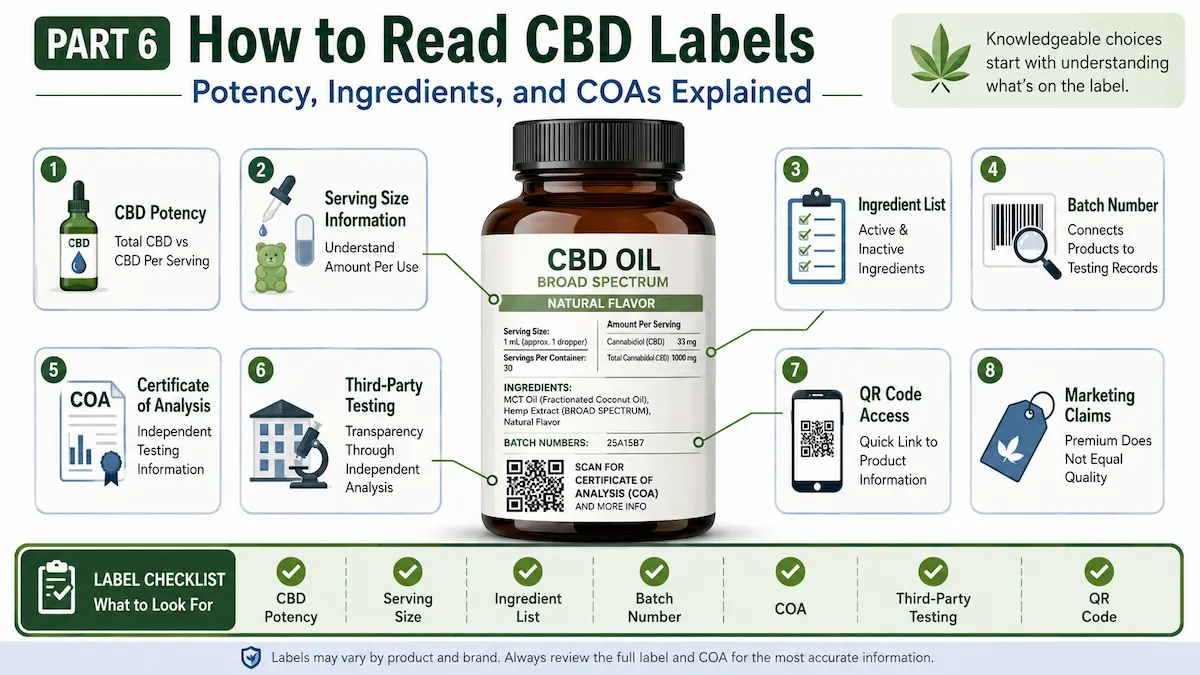
Total CBD vs CBD Per Serving
These are two different measurements.
Total CBD
This represents the amount of CBD contained in the entire package.
Example:
- Bottle contains 1,000 mg CBD
- Entire bottle = 1,000 mg total CBD
CBD Per Serving
This represents the amount of CBD contained in a single serving.
Example:
- Bottle contains 30 servings
- Total CBD = 1,000 mg
- CBD per serving = approximately 33 mg
Consumers frequently confuse these measurements, making it difficult to compare products accurately.
Always review both numbers before evaluating potency.
Understanding Serving Size Information
Serving size information helps explain how manufacturers calculate CBD content per use.
Depending on the product type, serving sizes may be listed as:
- One dropper
- One capsule
- One gummy
- A measured amount of topical product
- Another manufacturer-defined serving amount
Different CBD products use different serving methods.
To learn more about common product categories, see:
Understanding serving size allows consumers to compare products more effectively and interpret potency information correctly.
Reading Ingredient Lists
Like many consumer products, CBD products often include both active and inactive ingredients.
Reading ingredient lists can help consumers understand what is inside the product beyond CBD itself.
Active Ingredients
Active ingredients typically refer to ingredients that are central to the product formulation.
Examples may include:
- Cannabidiol (CBD)
- Hemp extracts
- Additional cannabinoids where applicable
The specific ingredients listed will vary by product type and formulation.
Inactive Ingredients
Inactive ingredients help create, preserve, flavor, or stabilize the product.
Examples may include:
- Carrier oils
- Natural flavors
- Sweeteners
- Preservatives
- Plant-based ingredients
Reviewing inactive ingredients may be especially useful for consumers who have dietary preferences or ingredient sensitivities.
Understanding Batch Numbers
Batch numbers are often overlooked, yet they play an important role in product transparency.
A batch number identifies a specific production batch associated with a product.
Manufacturers frequently use batch numbers to:
- Track production records
- Maintain quality-control documentation
- Connect products to laboratory reports
Batch numbers become especially important when reviewing Certificates of Analysis.
What Is a Certificate of Analysis (COA)?
A Certificate of Analysis (COA) is a laboratory report that provides testing information for a specific product batch.
COAs are commonly used throughout the CBD industry as a transparency tool.
What a COA Is
A COA is generally produced by a testing laboratory and may include information such as:
- Cannabinoid content
- Product identification
- Batch information
- Laboratory testing results
COAs help consumers review information beyond what appears on the product label.
Why Companies Provide COAs
Many companies provide COAs to increase transparency and allow consumers to review testing information independently.
Third-party testing may improve transparency by allowing product samples to be analyzed by laboratories separate from the manufacturer.
Consumers should understand that a COA is a testing document. It does not prove effectiveness or establish medical outcomes.
The U.S. Food and Drug Administration provides additional information regarding CBD products and consumer considerations:
Matching Batch Numbers
One of the most useful steps when reviewing a COA is confirming that the batch number on the product matches the batch number shown on the laboratory report.
Matching batch numbers helps confirm that the report is associated with the product in your possession.
If batch numbers do not match, the report may not correspond to the product being reviewed.
Reviewing Test Dates
Consumers should also review testing dates listed on laboratory reports.
Testing dates provide context regarding when the laboratory analysis occurred.
While dates alone do not determine product quality, they can help consumers understand the timeline associated with the report.
Understanding Cannabinoid Profiles
Many COAs include cannabinoid profile information.
These reports may list measured levels of cannabinoids found within a tested sample.
For readers interested in understanding how cannabinoids interact with the body, see:
Cannabinoid profile information should be viewed as analytical testing data rather than evidence of effectiveness.
Understanding Contaminant Testing
Some COAs may include testing information related to contaminants.
Depending on the laboratory and testing panel, reports may include analysis for:
- Heavy metals
- Microbial contaminants
- Residual solvents
- Other testing categories
Consumers can review these sections to better understand the scope of laboratory testing performed.
When reviewing laboratory reports, it may also be helpful to understand whether the testing facility follows recognized accreditation standards. The ANSI National Accreditation Board (ANAB) provides information regarding ISO/IEC 17025 accreditation for cannabis testing laboratories:
https://anab.ansi.org/accreditation/iso-iec-17025-cannabis-testing
Coming Soon Notice
How to Read and Use a CBD Certificate of Analysis (COA)
A future HempJuana educational resource will provide a detailed walkthrough of:
- Reading cannabinoid reports
- Understanding laboratory terminology
- Interpreting testing categories
- Reviewing contaminant sections
- Matching products to laboratory records
This future article will function as a standalone educational guide and is not part of the CBD Explained Series.
Understanding QR Codes
Many CBD products now include QR codes on their packaging.
When scanned with a smartphone, these codes often provide access to:
- Laboratory reports
- Product information
- Testing records
- Manufacturer resources
QR codes can simplify access to transparency information that would otherwise be difficult to place directly on a product label.
Common Marketing Terms Explained
CBD labels frequently contain marketing language that may sound impressive but provide limited information.
Understanding these terms can help consumers focus on verifiable information instead.
What They Mean
Terms such as:
- Premium
- Advanced Formula
- Enhanced
- Superior Blend
typically function as marketing descriptions rather than standardized testing classifications.
What They Do Not Mean
These terms do not automatically indicate:
- Higher quality
- Better testing
- Greater transparency
- Proven effectiveness
Consumers should prioritize verifiable information such as ingredient lists, batch numbers, COAs, and testing documentation rather than relying solely on marketing terminology.
7 Things to Check Before Buying Any CBD Product
Before purchasing a CBD product, consider reviewing the following:
1. Total CBD Amount
Understand how much CBD is contained in the entire package.
2. CBD Per Serving
Determine how much CBD is present in each serving.
3. Ingredient List
Review both active and inactive ingredients.
4. Batch Number
Confirm that a batch number is available.
5. COA Availability
Verify that laboratory reports are accessible.
6. Third-Party Testing
Look for evidence of independent laboratory testing.
7. QR Code Verification
Use QR codes when available to access supporting documentation.
Common CBD Label Mistakes Consumers Make
Some common mistakes include:
- Confusing total CBD with CBD per serving
- Ignoring ingredient lists
- Overlooking batch numbers
- Assuming marketing terms indicate quality
- Failing to review available COAs
- Assuming a COA proves effectiveness
- Treating product labels as medical evidence
Understanding these distinctions can help consumers evaluate products more effectively.
Frequently Asked Questions
What is CBD potency?
CBD potency refers to the amount of CBD contained in a product.
Is total CBD the same as CBD per serving?
No. Total CBD refers to the entire package, while CBD per serving refers to the amount contained in a single serving.
What is a batch number?
A batch number identifies a specific production batch and may help connect products to testing records.
What is a COA?
A Certificate of Analysis is a laboratory report that provides testing information for a specific product batch.
Do COAs prove that a product works?
No. COAs provide testing information and transparency but do not prove effectiveness.
Why do CBD products include QR codes?
QR codes often provide direct access to testing information and product documentation.
Should I trust marketing terms like “premium” or “advanced formula”?
These terms are marketing descriptions and should not be treated as evidence of product quality.
Conclusion
Understanding CBD labels can help consumers make more informed decisions when evaluating products. By learning how to interpret potency information, serving sizes, ingredient lists, batch numbers, COAs, and QR codes, consumers can focus on verifiable information rather than marketing language.
While labels and laboratory reports can improve transparency, they should not be interpreted as medical evidence or guarantees of effectiveness. Taking time to review available information can help consumers better understand what a product contains and how manufacturers communicate product details.
For additional information regarding hemp regulation and federal hemp standards, the USDA Hemp Program provides educational resources:
https://www.ams.usda.gov/rules-regulations/hemp
Consumers interested in labeling practices may also find the California Cannabis Labeling Guidance useful as an example of labeling and transparency requirements:
https://www.cannabis.ca.gov/licensees/cannaconnect-compliance-hub/labeling/manufactured-final-form
Footer
Version: v1.0
Based on verified statutory and regulatory sources current as of June 2026.
Editorial Note
This article is intended for informational and educational purposes only. It is based on publicly available regulatory, scientific, and industry sources available at the time of publication. HempJuana does not provide medical, legal, or professional advice. Readers should conduct their own research and consult qualified professionals when making decisions related to CBD products, health matters, or regulatory compliance.