
Executive Summary
How CBD is made from plant to product is one of the most common questions consumers have when learning about cannabidiol. CBD products appear in stores, online marketplaces, and wellness aisles across the United States, yet many people never see what happens before a CBD oil, gummy, capsule, or topical reaches a store shelf.
Understanding how CBD moves from hemp cultivation to a finished product can help consumers better understand labeling, testing, sourcing, and product transparency. While the process involves multiple stages, the basic journey is easier to understand than many people realize.
This article explores how hemp becomes CBD and how CBD eventually becomes the products consumers encounter every day.
Editor’s Note: This article was originally published on HempJuana and has been updated and expanded as part of our ongoing effort to provide accurate, current, and educational information about hemp and CBD.
Table of Contents
How CBD Starts With Hemp
CBD, short for cannabidiol, is one of many naturally occurring compounds found in cannabis plants. Most CBD products sold in the United States are derived from hemp.
Although hemp and marijuana belong to the same plant species, federal law distinguishes hemp as cannabis containing no more than 0.3% delta-9 THC on a dry-weight basis. This distinction was established through federal legislation and helped create a pathway for legal hemp cultivation.
For readers new to the topic, our article CBD 101 Basics Guide provides a foundational overview, while What Is CBD and How Is It Different From THC? explains the differences between CBD and THC in greater detail.
Because hemp can produce meaningful amounts of CBD while remaining within federal THC limits, it has become the primary source material for many CBD products available today.
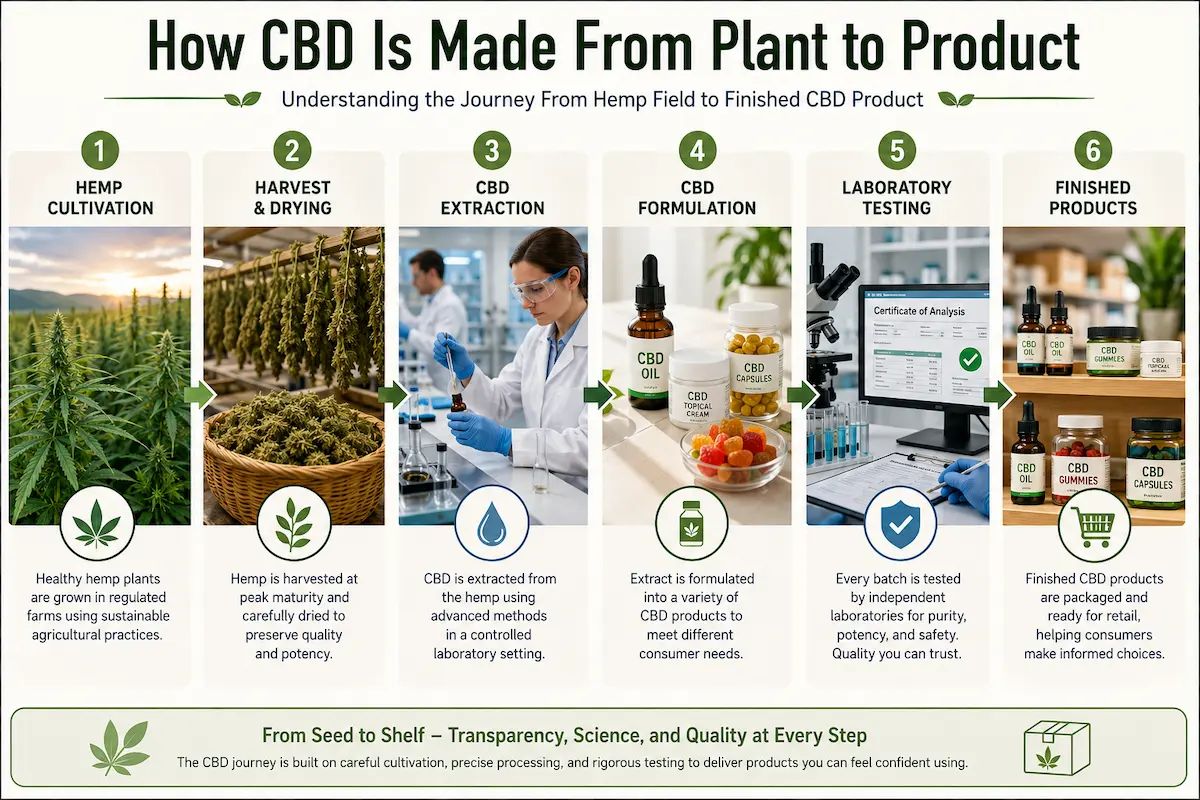
Step 1: Growing Hemp for CBD
The journey begins with hemp cultivation.
Farmers growing hemp for cannabinoid production typically select hemp varieties that are known for producing higher concentrations of CBD while remaining within applicable THC limits.
Like many agricultural crops, hemp goes through several stages:
- Planting
- Growth and cultivation
- Monitoring plant development
- Flower production
- Harvest preparation
Growing conditions such as weather, soil quality, sunlight exposure, irrigation, and genetics can all influence crop development.
For CBD production, growers generally focus on cannabinoid-rich flowers because these portions of the plant contain the highest concentrations of cannabinoids.
Consumers may never see this stage, but every CBD product begins in the field.
Additional information about hemp cultivation can be found through the USDA Hemp Program:
https://www.ams.usda.gov/rules-regulations/hemp
Step 2: Harvesting and Preparing the Plant
Once hemp reaches maturity, farmers begin harvesting.
Timing can be important because cannabinoid levels naturally change as plants develop. Growers generally harvest when the crop has reached the desired stage of maturity.
After harvest, plant material typically undergoes:
- Drying
- Trimming
- Processing
- Preparation for extraction
Drying helps reduce moisture content and prepares the harvested material for the next phase of production.
At this point, the hemp plant transitions from an agricultural crop into a raw material used for cannabinoid extraction.
Step 3: Extracting CBD From Hemp
Extraction is the process used to separate cannabinoids and other plant compounds from hemp biomass.
Consumers may occasionally see extraction methods referenced on company websites, product packaging, or educational materials.
CO₂ Extraction
One commonly referenced method is CO₂ extraction.
This process uses carbon dioxide under controlled conditions to help separate cannabinoids from hemp plant material.
Consumers frequently encounter references to CO₂ extraction because it has become one of the industry’s widely discussed extraction methods.
Ethanol Extraction
Another common approach is ethanol extraction.
This method uses food-grade ethanol to help extract cannabinoids and other compounds from hemp biomass.
Like CO₂ extraction, ethanol extraction is commonly used within the hemp industry and may be referenced in manufacturing information provided by companies.
Why Extraction Matters
The goal of extraction is to create concentrated hemp extracts that can later be incorporated into finished consumer products.
From a consumer perspective, extraction serves as the bridge between harvested hemp and the CBD ingredients used in oils, gummies, capsules, topicals, and other products.
Step 4: Turning CBD Extract Into Products
After extraction, CBD-rich ingredients can be formulated into a wide variety of product categories.
CBD Oils and Tinctures
CBD extracts may be combined with carrier oils and packaged into liquid products.
CBD Gummies
CBD ingredients can be incorporated into edible gummy formulations.
CBD Capsules
Capsules provide a pre-measured format that some consumers prefer.
CBD Topicals
Creams, lotions, balms, and other external-use products may contain CBD extracts.
CBD Beverages
Some manufacturers formulate CBD into beverages and drink additives.
This stage of the process explains why consumers encounter CBD in many different forms despite the products often originating from similar hemp-derived ingredients.
For a deeper look at product categories, continue to Types of CBD Products, the next article in the CBD Explained Series.
Step 5: Testing CBD Products
Testing is an important part of product transparency.
Many manufacturers choose to have products analyzed by independent third-party laboratories.
Laboratory testing may include:
- Cannabinoid verification
- THC content verification
- Contaminant screening
- Additional product analysis
What Is a Certificate of Analysis (COA)?
A Certificate of Analysis, commonly called a COA, is a laboratory document that may provide information about a product’s testing results.
Depending on the manufacturer, consumers may access COAs through:
- QR codes
- Product pages
- Company websites
- Customer support requests
Consumers should remember that testing practices can vary among manufacturers and products.
Understanding how to locate and review a COA can help consumers evaluate available product information.
The FDA provides additional information regarding cannabis-derived products and cannabidiol:
Step 6: Labeling, Packaging, and Retail Sale
Before products reach consumers, they are typically packaged and labeled.
Product labels may include:
- Product name
- Ingredient list
- CBD content
- Serving information
- Manufacturer information
- Batch identifiers
- Usage instructions
Some packaging also includes links to testing information or educational resources.
Once packaged, products may become available through:
- Online retailers
- Specialty stores
- Wellness retailers
- Other lawful sales channels
Availability can vary depending on applicable laws and regulations.
Consumers seeking regulatory information can review resources provided by the CDC and NCCIH:
https://www.cdc.gov/cannabis/about/about-cbd.html
https://www.nccih.nih.gov/health/cannabis-marijuana-and-cannabinoids-what-you-need-to-know
Why Understanding How CBD Is Made From Plant to Product Matters
Understanding how CBD moves from cultivation to retail shelves can help consumers become more informed researchers.
Knowledge of the process can help readers:
- Better understand product labels
- Interpret testing information
- Evaluate sourcing transparency
- Understand manufacturing descriptions
- Ask more informed questions
Consumers do not need to become extraction experts or manufacturing specialists to benefit from understanding the basics.
A general understanding of the process provides valuable context when researching CBD products.
What Consumers Should Look For
When researching CBD products, consumers may wish to look for:
Clear Labeling
Labels should clearly identify ingredients and product information.
Available Testing Information
When available, COAs can provide additional transparency regarding laboratory testing.
Transparent Company Information
Companies that clearly explain their products, sourcing practices, and testing information may provide consumers with additional educational resources.
Realistic Expectations
CBD products vary significantly in ingredients, cannabinoid content, formulations, and intended uses.
Understanding these differences can help consumers make more informed decisions.
Conclusion
The journey from hemp plant to finished CBD product involves several stages:
Hemp Cultivation
↓
Harvesting
↓
Preparation of Plant Material
↓
Extraction
↓
Product Formulation
↓
Testing
↓
Packaging and Labeling
↓
Retail Sale
While consumers often see only the finished product, understanding the steps behind the process provides valuable context about how CBD products are created.
Now that you understand how CBD moves from the field to the shelf, continue with the next article in the series:
Next Reading: Types of CBD Products
You may also find these companion articles helpful:
- CBD 101 Basics Guide
- What Is CBD and How Is It Different From THC?
- How CBD Interacts With the Body
- The Legal Side of CBD
Version: v1.0
Based on verified statutory and regulatory sources current as of May 2026.
Editorial Note
This article is provided for informational and educational purposes only. It is based on publicly available information and should not be considered legal, medical, financial, or professional advice. Laws, regulations, and industry practices may change over time. Readers should conduct their own research and consult qualified professionals before making decisions regarding hemp, CBD, or cannabis-related products.