
If you’ve spent any time researching CBD, you’ve probably noticed that the question of legality comes up almost immediately. CBD products are sold online, found in wellness stores, and discussed everywhere from social media to mainstream news. Yet many consumers still wonder: Is CBD actually legal?
The answer is more complicated than a simple yes or no.
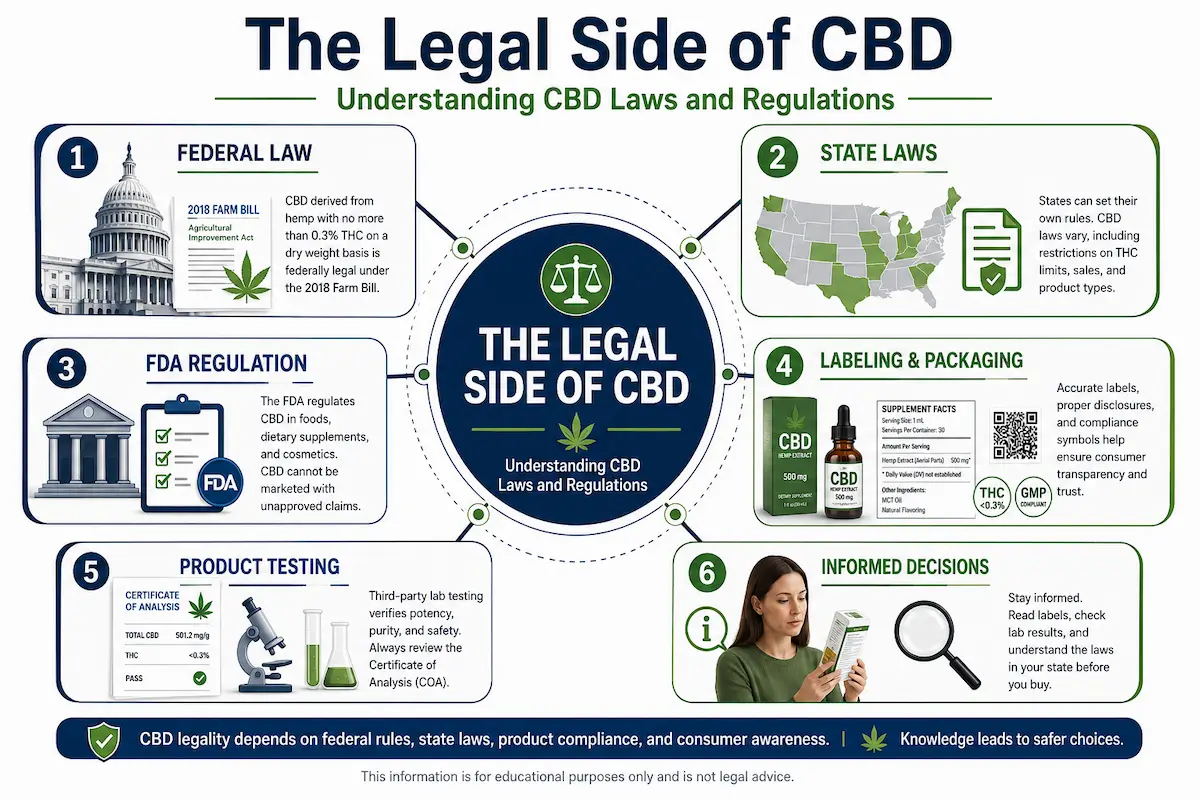
Federal hemp laws, FDA regulations, and state-level rules all influence how CBD products are produced, marketed, and sold. Understanding these basics can help consumers make informed decisions and avoid common misconceptions.
If you’re new to CBD, consider starting with our CBD 101 Basics Guide, which provides a broad introduction before diving into more specific topics like legality.
Executive Summary
CBD legality in the United States is shaped by a combination of federal laws, state regulations, and FDA oversight. The 2018 Farm Bill created the modern federal framework for hemp by defining hemp as cannabis containing no more than 0.3% delta-9 THC and removing qualifying hemp from federal controlled substance treatment.
However, hemp legalization did not automatically make every CBD product legal. The FDA continues to regulate how CBD products are marketed, while individual states may impose additional restrictions on hemp-derived products.
Table of Contents
Consumers researching CBD should understand the difference between federal and state laws, review product testing information, and look for Certificates of Analysis (COAs) before making a purchase.
Key Takeaways
Not all CBD products are automatically legal in every jurisdiction.
Hemp and marijuana are treated differently under federal law.
The 2018 Farm Bill established the modern hemp framework.
Hemp-derived CBD may be federally lawful under specific conditions.
State laws can impose additional requirements or restrictions.
The FDA regulates product claims and consumer protections.
Third-party testing and COAs help consumers evaluate product quality.
Why CBD Legality Confuses So Many Consumers
One reason CBD legality can be confusing is that several different laws and regulatory agencies are involved.
Many consumers hear that hemp is legal and assume all CBD products are automatically legal everywhere. Others hear about restrictions in certain states and conclude that CBD must be illegal.
Neither assumption tells the full story.
CBD exists within a regulatory framework that includes:
- Federal hemp laws
- FDA oversight
- State regulations
- Product-specific requirements
Adding to the confusion, CBD is derived from cannabis. While hemp and marijuana both come from the Cannabis sativa plant, federal law treats them differently.
Understanding these distinctions is essential to understanding CBD legality.
What Changed Under the 2018 Farm Bill?
To understand modern CBD laws, it helps to understand what changed under the 2018 Farm Bill.
Historical Context: This section explains the foundation of today’s hemp laws.
The Agriculture Improvement Act of 2018, commonly called the 2018 Farm Bill, created the modern federal framework for hemp production in the United States.
Under federal law, hemp is defined as cannabis containing no more than 0.3% delta-9 THC on a dry-weight basis. Hemp meeting this definition is treated differently from marijuana under federal law.
The Farm Bill also established a pathway for regulated hemp cultivation and helped create the foundation for today’s hemp-derived CBD marketplace.
Readers interested in the federal hemp program can review the USDA Domestic Hemp Production Program:
https://www.ams.usda.gov/rules-regulations/hemp
If you’re unfamiliar with the differences between hemp, marijuana, CBD, and THC, our article What Is CBD and How Is It Different From THC? provides a helpful foundation.
Is CBD Legal at the Federal Level?
The short answer is that hemp-derived CBD may be legal at the federal level under certain circumstances.
However, federal legality depends on multiple factors, including:
- Source material
- THC content
- Product category
- Manufacturing practices
- Marketing claims
- Regulatory requirements
Federal Legality Does Not Mean Universal Approval
One of the biggest misconceptions surrounding CBD is that hemp legalization automatically made every CBD product legal.
Federal hemp laws and FDA regulations operate separately.
While hemp-derived CBD may fall within the federal hemp framework, the U.S. Food and Drug Administration (FDA) still maintains authority over products containing cannabis-derived compounds.
The FDA’s current position regarding cannabis-derived products and CBD can be reviewed here:
Consumers should avoid assuming that every CBD product currently available on the market has received FDA approval or review.
To better understand how CBD moves from the hemp plant to finished products, see our article How CBD Is Made From Plant to Product.
Why State Laws Can Be Different
Although federal law provides a national framework for hemp, states retain authority to regulate hemp-derived products within their borders.
As a result, CBD regulations can vary from state to state.
Some states largely follow federal hemp standards, while others have adopted additional requirements related to:
- Product testing
- Labeling
- Retail sales
- Cannabinoid restrictions
- Consumer protections
Because laws can change over time, consumers should review local regulations before purchasing CBD products or traveling with them.
The key takeaway is simple:
Federal legality does not eliminate state-level authority.
The FDA and CBD Products
The FDA plays a significant role in the CBD marketplace.
The agency oversees product categories, labeling practices, and marketing claims involving cannabis-derived ingredients.
One area of particular focus involves medical claims.
Companies generally cannot market CBD products as treatments, cures, or preventive measures for diseases unless they have completed the appropriate regulatory approval process.
The FDA has also stated that current regulatory pathways for conventional foods and dietary supplements are not specifically designed for CBD products.
Consumers interested in FDA guidance can review the agency’s consumer education resource:
For consumers, the lesson is straightforward: be cautious of exaggerated marketing claims and focus on transparent product information.
What Consumers Should Look For Before Buying CBD
Understanding legality is important, but consumers should also understand how to evaluate product quality.
Certificates of Analysis (COAs)
A Certificate of Analysis, commonly called a COA, is a laboratory report that provides information about a product’s contents.
A COA may include:
- Cannabinoid levels
- THC content
- Laboratory testing results
- Product verification information
Many reputable CBD companies provide COAs through QR codes or product pages.
Third-Party Testing
Independent laboratory testing helps verify that products contain what their labels claim.
Testing may also screen for contaminants and other quality concerns.
Third-party testing has become one of the most important transparency tools available to consumers.
Product Transparency
Consumers should look for clear information regarding:
- Ingredients
- Manufacturer identity
- Batch numbers
- Testing availability
- Contact information
The more transparent a company is, the easier it becomes for consumers to make informed purchasing decisions.
You can also explore our guide to Types of CBD Products to learn more about the different forms CBD is commonly sold in.
Frequently Asked Questions About CBD Legality
Is CBD legal in every state?
Not necessarily.
Federal hemp laws provide a framework for hemp-derived products, but states may adopt additional restrictions and requirements.
Can I travel with CBD?
Travel rules may vary depending on the product and the jurisdictions involved.
Consumers should review applicable laws before traveling, especially across state lines.
Will CBD show up on a drug test?
CBD itself is generally not the target of most drug tests.
However, some CBD products may contain trace amounts of THC. Because product formulations vary, THC exposure remains possible depending on the product used.
Are all CBD products legal?
No.
Factors such as THC content, product type, marketing claims, and state regulations can all affect legality.
How can I verify a CBD product?
Start by reviewing:
- Certificates of Analysis (COAs)
- Third-party testing information
- Product labeling
- Manufacturer transparency
These resources can help consumers better understand what they are purchasing.
Final Thoughts
CBD legality is often more nuanced than many consumers expect.
The 2018 Farm Bill established the foundation for today’s hemp industry, but federal law is only one piece of the larger regulatory picture.
State regulations, FDA oversight, labeling requirements, and product transparency all play important roles in how CBD products are regulated and sold.
For consumers, the best approach is to stay informed, review product information carefully, and purchase products from companies that prioritize transparency and quality.
As you continue learning about CBD, our article How CBD Interacts With the Body explores what happens after CBD is consumed and how it interacts with the body’s natural systems.
Disclaimer: This article is for educational and informational purposes only and should not be considered legal advice. Laws and regulations may change and can vary by jurisdiction.
Last Updated: June 2026
Series: CBD Explained – Part 4