
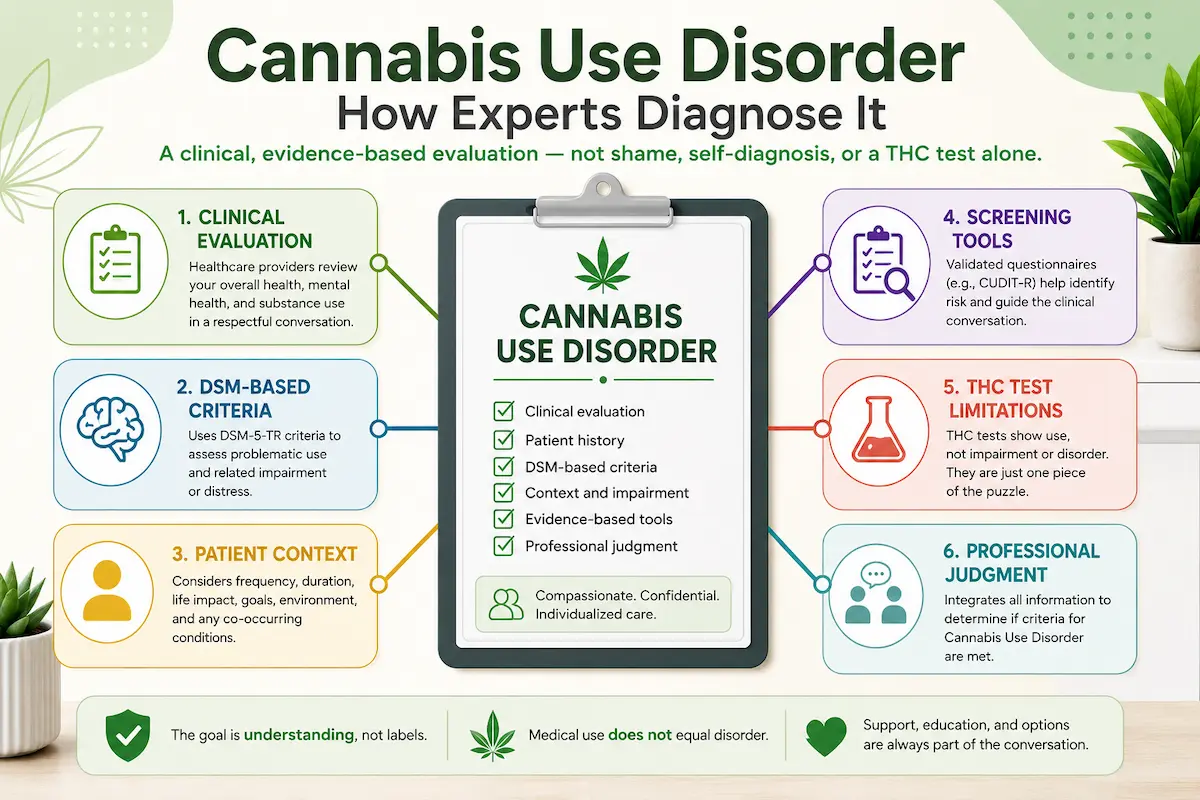
Cannabis use disorder is a clinical term used when cannabis use becomes difficult to control and begins causing meaningful problems in a person’s health, relationships, responsibilities, safety, or daily life. It is not decided by stigma, moral judgment, frequency alone, medical cannabis use alone, or a single THC-positive test.
This article explains how clinicians and public-health experts evaluate Cannabis Use Disorder in a careful, stigma-free way. It is designed to help readers understand the diagnostic process, not to diagnose themselves or someone else.
Medical disclaimer: This article is for education only. It is not a diagnostic tool and cannot determine whether a person has Cannabis Use Disorder. Diagnosis should be made by a qualified healthcare or mental-health professional who can consider symptoms, medical history, cannabis-use patterns, medications, mental health, and life context.
Urgent-help safety note: If someone may be in immediate danger, is at risk of harming themselves or others, or is experiencing a crisis, seek emergency help right away through local emergency services or an appropriate crisis-support resource.
Table of Contents
What Is Cannabis Use Disorder?
Cannabis Use Disorder, often shortened to CUD, describes a pattern of cannabis use that becomes clinically concerning because it is connected to impaired control, distress, consequences, or functional problems.
The Centers for Disease Control and Prevention describes Cannabis Use Disorder as a condition in which some cannabis users have difficulty stopping cannabis use even when it is causing health or social problems. The CDC also reports that some cannabis users develop CUD, but this does not mean every cannabis user has CUD.
Cannabis can be addictive for some people, but a clinical diagnosis depends on more than whether a person uses cannabis. Clinicians look at patterns over time, including how cannabis use affects responsibilities, relationships, safety, mental health, physical health, and the person’s ability to reduce or stop use when they want to. For a broader parent resource on cannabis science and health research, see Cannabis and Human Health.
How Clinicians Diagnose Cannabis Use Disorder
NCBI / StatPearls explains that Cannabis Use Disorder is evaluated through clinical assessment, screening tools, structured interviews, and clinical judgment. Clinicians do not diagnose CUD with one simple test.
Assessment may include a clinical conversation, review of symptoms, cannabis-use patterns, medical history, mental-health context, medications, functional impact, and other relevant life context.
The main U.S. diagnostic framework for this article is DSM-5-TR. NCBI’s DSM-5 substance-use disorder summaryexplains that substance-use criteria fit broader domains such as impaired control, social impairment, risky use, and pharmacologic features.
A diagnosis is not based only on:
Using cannabis daily
Using cannabis medically
Having THC in a drug test
Having tolerance by itself
Having withdrawal by itself
Using high-potency THC products by itself
Those details may matter, but they are not enough on their own. The broader clinical question is whether cannabis use is connected to impaired control, social impairment, risky use, pharmacologic features, distress, or real-life consequences.
The DSM-5-TR Criteria: What Doctors Look For
NCBI’s DSM-based Cannabis Use Disorder summary explains that diagnosis requires at least 2 of 11 criteria within a 12-month period.
The criteria include patterns such as impaired control, craving, role impairment, social problems, hazardous use, continued use despite harm, tolerance, and withdrawal. NCBI’s DSM-5 substance-use disorder table places these criteria into broader domains, including impaired control, social impairment, risky use, and pharmacologic features.
Clinicians may consider CUD when cannabis use involves problems such as using more than intended, being unable to cut down despite wanting to, craving cannabis, continued use despite problems, difficulty meeting responsibilities, or use in risky situations.
This does not mean a reader should count symptoms and diagnose themselves. The same behavior can have different meanings depending on medical context, mental health, medications, age, use pattern, and functional impact. A qualified healthcare or mental-health professional should interpret those details.
Mild, Moderate, and Severe Cannabis Use Disorder
NCBI’s DSM-based substance-use disorder summary explains that severity levels are based on the number of criteria met within 12 months.
Mild Cannabis Use Disorder involves 2 to 3 criteria.
Moderate Cannabis Use Disorder involves 4 to 5 criteria.
Severe Cannabis Use Disorder involves 6 or more criteria.
Severity does not describe a person’s worth, character, or morality. It describes how many diagnostic criteria are present and helps clinicians understand the level of clinical concern.
This is one reason professional assessment matters. A person may have cannabis-related concerns without meeting the threshold for CUD, or they may meet criteria while still appearing functional in some areas of life.
Screening Tools Are Not the Same as Diagnosis
NCBI / StatPearls identifies screening tools as part of the assessment landscape, but screening tools do not confirm Cannabis Use Disorder by themselves.
Tools such as the CUDIT-R, CUDIT-C, SIS-C, and ASSIST may be used to support a clinical conversation. They can help a provider ask more focused questions about cannabis use, risk patterns, and possible impairment.
A screening score is not the same thing as a formal diagnosis. Screening tools are best understood as conversation guides or risk flags. They should not be used as a self-diagnosis shortcut, and they should not be used to label another person. A qualified healthcare or mental-health professional must interpret results in context.
This distinction matters because cannabis use can involve medical, recreational, cultural, legal, occupational, and mental-health factors. A tool may identify concern, but it cannot replace clinical judgment.
Why a THC Test Cannot Diagnose Cannabis Use Disorder
NCBI / StatPearls explains that toxicology testing can confirm cannabis exposure, but it cannot diagnose Cannabis Use Disorder.
A THC test can show cannabis exposure or THC metabolites. It does not show CUD severity. It does not prove addiction. It does not determine impairment by itself. It also does not explain why someone used cannabis, whether the use was medical, or whether cannabis use is causing functional problems.
This is important because CUD is not defined by the presence of THC alone. It is evaluated through behavior, impairment, control, consequences, and clinical context.
A positive THC test may be relevant in certain medical, workplace, legal, or safety settings, but it should not be confused with a mental-health or substance-use diagnosis. For a basic explanation of how THC differs from CBD, see What Is CBD and How Is It Different from THC?
Cannabis Withdrawal, Tolerance, and Craving
The National Institute on Drug Abuse describes Cannabis Use Disorder as something some cannabis users may develop and notes that some people may experience withdrawal symptoms. NIDA describes withdrawal symptoms that may include irritability, anger or aggression, nervousness or anxiety, and sleep disturbance.
A clinical review indexed in PubMed also identifies cannabis withdrawal symptoms that can include anxiety, irritability, anger or aggression, disturbed sleep or dreams, depressed mood, appetite loss, and related symptoms.
That clinical review indicates that withdrawal symptoms often begin within 24 to 48 hours after stopping, may peak around days 2 to 6, and may last up to 3 weeks or more for some people. This timeline should be understood as a general clinical pattern, not a prediction for every individual.
Craving may also be part of the clinical picture. In a diagnostic setting, craving is considered alongside other signs of impaired control, consequences, and continued use despite problems.
Tolerance means a person may need more cannabis to get the same effect, or the same amount may produce less effect over time. Tolerance can be one possible diagnostic criterion, but NCBI’s DSM-based guidance requires careful interpretation.
Tolerance and withdrawal alone should not automatically be treated as proof of Cannabis Use Disorder, especially when cannabis is being used in an appropriate medical-treatment context.
Medical Cannabis Use Requires Clinical Nuance
Medical cannabis use does not automatically mean a person has Cannabis Use Disorder.
NCBI / StatPearls and a JAMA Psychiatry viewpoint indexed in PubMed support the need to interpret tolerance and withdrawal carefully in therapeutic contexts. A person may use cannabis under medical guidance or for symptom-related reasons without meeting criteria for CUD.
At the same time, medical cannabis patients can still develop problematic use patterns. The point is not to assume either direction.
Clinical nuance matters because tolerance can occur in medical contexts. Withdrawal can also occur in medical contexts. Those features alone do not prove addiction or problematic use.
A careful assessment should consider control, distress, consequences, functional impairment, medical history, mental health, medications, and the purpose of cannabis use.
This is also why patient-provider trust matters. People should be able to discuss cannabis use honestly with healthcare professionals without shame-based language or fear that any cannabis use will automatically be judged as addiction.
Reminder: This article cannot determine whether medical cannabis use is appropriate, inappropriate, problematic, or diagnostic of CUD. That judgment requires a qualified healthcare or mental-health professional who can evaluate the full clinical context.
High-Potency THC and CUD Risk: What Evidence Can and Cannot Say
The CDC identifies high-concentration THC products as a public-health concern because they can produce stronger intoxicating effects and increase overconsumption risk.
The CDC also cautions that researchers do not yet know the full consequences of high-concentration THC exposure or exactly how recent potency increases affect Cannabis Use Disorder risk.
A peer-reviewed systematic review indexed in PubMed supports cautious association language: higher-potency cannabis use has been associated with increased risk of CUD, and high-concentration THC products may be associated with more severe CUD symptoms.
That wording matters. Association does not prove direct causation. High-potency THC does not automatically cause Cannabis Use Disorder. Potency may be one risk concern among many, but diagnosis still depends on clinical criteria, impairment, control, consequences, and context.
A balanced explanation should avoid both extremes. It should not dismiss potency concerns, but it also should not claim that potency alone determines addiction. For related background on potency changes, see Why Modern Cannabis Feels Stronger Than It Used To.
For related background on potency changes, see Why Modern Cannabis Feels Stronger Than It Used To.
How ICD-11 Compares Internationally
DSM-5-TR is the main U.S. diagnostic framework used in this article.
The World Health Organization’s ICD-11 is the international standard for diagnostic health information. ICD-11 includes cannabis-related disorders and cannabis dependence as classifications.
However, ICD-11 should not replace DSM-5-TR as the main framework for U.S. readers in this article. Also, detailed ICD-11 cannabis-dependence wording should not be quoted unless the official WHO entity page is manually confirmed.
The practical point is that both U.S. and international systems recognize that cannabis-related problems can become clinically significant, but this article keeps DSM-5-TR as the main diagnostic backbone.
How to Talk With a Healthcare Professional Without Stigma
A healthcare conversation about cannabis should not begin with shame. It should begin with clarity.
A person may want to talk with a qualified professional if cannabis use feels difficult to control, is causing problems at work or school, is affecting relationships, is being used in risky situations, or continues despite health or social problems.
It can help to describe patterns plainly:
How often cannabis is used
What types of products are used
Whether use has increased over time
Whether cutting down has been difficult
Whether cannabis use is affecting sleep, mood, work, school, relationships, or safety
Whether cannabis is being used medically
Whether withdrawal symptoms appear after stopping or reducing use
These details can help a clinician understand context without reducing the person to a label.
SAMHSA has issued guidance on Cannabis Use Disorder in healthcare settings. In this article, that guidance is used only to support the broader point that CUD can be relevant in healthcare and primary-care conversations.
For people seeking mental-health or substance-use support, the SAMHSA National Helpline is an appropriate resource to mention.
For related youth and mental-health context, see Adolescent Cannabis Psychiatric Risk: 2026 Kaiser Review. This article does not provide treatment instructions. Treatment decisions should be made with qualified professionals.
Key Takeaways
Cannabis Use Disorder is a clinical diagnosis, not a moral judgment.
DSM-5-TR is the main U.S. diagnostic framework for this article.
NCBI’s DSM-based summary explains that Cannabis Use Disorder diagnosis requires at least 2 of 11 criteria within 12 months.
NCBI’s DSM-based summary explains that severity is described as mild, moderate, or severe based on the number of criteria met.
Screening tools can identify risk but do not confirm diagnosis.
A THC test can show exposure, but NCBI / StatPearls explains that it cannot diagnose CUD, severity, impairment, or addiction by itself.
Daily cannabis use does not automatically mean addiction.
Medical cannabis use does not automatically mean CUD.
Tolerance and withdrawal require clinical context.
CDC guidance and a peer-reviewed systematic review support cautious concern about high-potency THC, but association should not be overstated as direct causation.
A qualified healthcare or mental-health professional is the right person to diagnose Cannabis Use Disorder.
Frequently Asked Questions
Is cannabis use disorder the same as addiction?
Cannabis Use Disorder is the clinical term used in diagnostic settings. Addiction is a broader public-facing term that may overlap with severe or problematic use, but clinical language should be used carefully. Cannabis can be addictive for some people, but CUD is evaluated through diagnostic criteria, impairment, consequences, and clinical context.
Can a THC test prove someone has CUD?
No. NCBI / StatPearls explains that toxicology can show cannabis exposure, but it cannot diagnose Cannabis Use Disorder. It also cannot determine severity, addiction, or impairment by itself.
How many symptoms are needed for CUD?
NCBI’s DSM-based Cannabis Use Disorder summary explains that diagnosis requires at least 2 of 11 criteria within a 12-month period. Severity is mild with 2 to 3 criteria, moderate with 4 to 5, and severe with 6 or more.
Does daily cannabis use mean someone is addicted?
No. The CDC identifies frequent use as a risk factor, but diagnosis depends on impaired control, distress, consequences, functional impact, and clinical context. Daily use alone is not enough to diagnose Cannabis Use Disorder.
Can medical cannabis patients have CUD?
Yes, it is possible for a medical cannabis patient to have CUD, but medical cannabis use does not automatically mean addiction or CUD. NCBI / StatPearls clinical summary and a JAMA Psychiatry viewpoint support the need to interpret tolerance and withdrawal carefully in therapeutic contexts. Clinicians should consider function, control, consequences, distress, medical history, and purpose of use.
What is cannabis withdrawal?
NIDA and a clinical review indexed in PubMed identify cannabis withdrawal symptoms that may include anxiety, irritability, anger or aggression, disturbed sleep or dreams, depressed mood, appetite loss, and related symptoms. The clinical review indicates symptoms often begin within 24 to 48 hours after stopping, may peak around days 2 to 6, and may last up to 3 weeks or more for some people. Individual experiences can vary.
Are high-THC products more addictive?
The CDC identifies high-concentration THC products as a public-health concern because they can produce stronger intoxicating effects and may increase overconsumption risk. A peer-reviewed systematic review has associated higher-potency cannabis use with increased CUD risk, and high-concentration THC products may be associated with more severe symptoms. However, association does not prove direct causation, and high-potency THC does not automatically cause addiction.
Who can diagnose Cannabis Use Disorder?
Cannabis Use Disorder should be diagnosed by a qualified healthcare or mental-health professional. A professional can evaluate symptoms, medical history, cannabis-use patterns, mental health, medications, and life context.
Final Source List
NCBI Bookshelf / StatPearls: Cannabis Use Disorder — DSM criteria summary, clinical assessment, screening tools, and toxicology limits.
NCBI Bookshelf: DSM-5 Substance Use Disorder criteria summary — severity thresholds and substance-use domains.
Centers for Disease Control and Prevention: Cannabis Use Disorder — public-health definition, prevalence, warning signs, youth/frequency risk, and high-THC caution.
Centers for Disease Control and Prevention: About Cannabis — cannabis public-health context and product-risk factors.
Substance Abuse and Mental Health Services Administration: Cannabis Use Disorder healthcare-setting guidance— healthcare-provider and primary-care relevance only.
Substance Abuse and Mental Health Services Administration: National Helpline — resource mention for people seeking mental-health or substance-use support.
National Institute on Drug Abuse: Cannabis — addiction, withdrawal, and treatment-context support.
World Health Organization: ICD-11 — international comparison only.
Clinical Management of Cannabis Withdrawal, PubMed — withdrawal symptoms and general timeline.
Association of Cannabis Potency With Mental Ill Health and Addiction, PubMed — cautious association language for high-potency THC and CUD risk.
Recommendation for Cannabis Use Disorder Diagnosis in a Context of Cannabis for Therapeutic Purposes, PubMed — medical cannabis diagnostic nuance.
Internal Links Added / Suggested
Cannabis and Human Health — Added near the beginning as parent/pillar support.
Why Modern Cannabis Feels Stronger Than It Used To — Added in the high-potency THC section as related reading.
Adolescent Cannabis Psychiatric Risk: 2026 Kaiser Review — Optional related reading only. Use only if you want a youth/mental-health context link.
Part 1: What Is CBD and How Is It Different from THC? — Optional support link if you want a THC vs CBD explainer connection.
Editorial Note
This article is informational and educational. It is based on publicly available medical, public-health, and diagnostic-source categories identified during the verification process. It is not medical advice, mental-health advice, legal advice, or a diagnostic tool. Readers should speak with qualified healthcare or mental-health professionals and conduct their own research before making decisions related to cannabis use, Cannabis Use Disorder, screening, diagnosis, or care.
Version: Publication Draft v1.0
Based on verified medical and public-health source categories current as of July 2026.