
Executive Summary
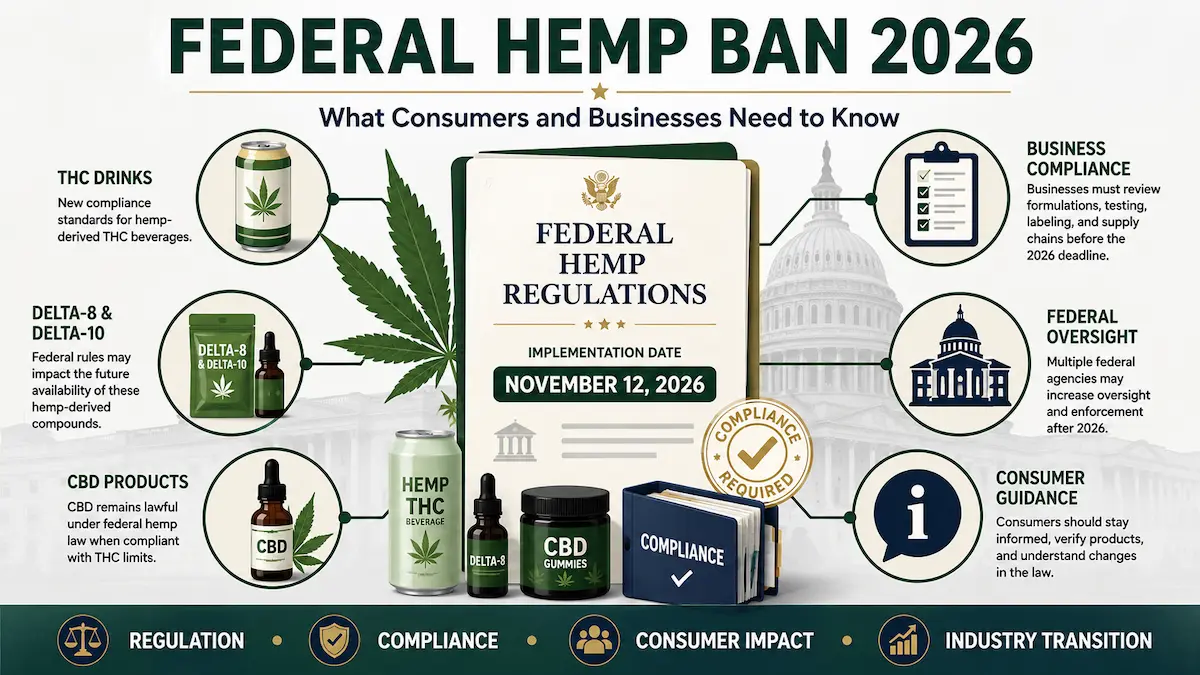
The federal hemp ban 2026 debate has generated significant confusion among consumers, retailers, and manufacturers across the United States. While federal hemp law changes scheduled for implementation on November 12, 2026, may significantly affect certain intoxicating hemp-derived cannabinoid products, the available evidence does not support claims that all hemp products or all CBD products will become illegal.
Instead, the revised federal framework introduces a total THC-based standard that may affect products such as Delta-8 THC, Delta-10 THC, THC beverages, and certain hemp-derived edibles. Businesses may need to adjust formulations, labeling, testing procedures, and compliance strategies, while consumers may notice changes in product availability and labeling requirements.
This article explains what is changing, what remains uncertain, and what consumers and businesses should know as implementation approaches.
Table of Contents
Understanding the 2026 Federal Hemp Changes
Many consumers first learned about the upcoming changes through headlines discussing a possible federal hemp ban. In reality, the situation is more nuanced.
Federal hemp law changes enacted in 2025 are scheduled to take effect on November 12, 2026. The revised framework changes how hemp-derived products are evaluated under federal law and introduces new compliance considerations for certain cannabinoid products.
For readers seeking broader background on federal cannabis regulations, see Cannabis Policy and Law in the United States.
The upcoming changes do not automatically prohibit all hemp products, all CBD products, or every hemp business. Instead, they establish new criteria that determine whether products continue to qualify as federally exempt hemp.
What Is Changing?
Historically, federal hemp regulations focused heavily on Delta-9 THC concentration limits.
Under the revised framework, regulators increasingly focus on total THC calculations when determining whether a product qualifies as lawful hemp.
The change is intended to address concerns regarding intoxicating hemp-derived cannabinoid products that have expanded rapidly in recent years.
The updated federal framework may affect manufacturers, retailers, distributors, and consumers differently depending on product type, formulation, and intended market.
For additional background on federal hemp definitions, see Hemp vs Marijuana Under Federal Law.
For information regarding federal hemp production programs, visit the USDA Hemp Program:
https://www.ams.usda.gov/rules-regulations/hemp
What Is the New THC Standard?
One of the most important changes involves the use of a total THC-based framework.
In simple terms, total THC attempts to account for the overall amount of THC that may be present within a product rather than focusing solely on a single cannabinoid measurement.
For consumers, this may result in:
- More detailed product testing
- Revised product labeling
- Changes to product formulations
- Greater emphasis on compliance documentation
For businesses, the shift may require updated testing protocols and compliance reviews.
Readers interested in the federal statutory hemp definition can review:
https://uscode.house.gov/view.xhtml?req=(title:7%20section:1639o%20edition:prelim)
Which Hemp Products Are Most Affected?
Several product categories appear to face elevated compliance risk under the revised framework.
These include:
- Delta-8 THC products
- Delta-10 THC products
- THC beverages
- Certain hemp-derived edibles
- Other intoxicating hemp-derived cannabinoid products
Not every product within these categories will necessarily be affected in the same way. Product formulation, THC content, testing methods, and future agency guidance may all influence compliance outcomes.
What Happens to THC Drinks?
THC beverages have become one of the fastest-growing segments of the hemp marketplace.
However, the revised federal framework may create significant compliance challenges for many existing beverage products.
Consumers may experience:
- Product reformulations
- Product discontinuations
- New labeling requirements
- State-by-state availability differences
Businesses may need to review:
- Ingredient profiles
- Testing procedures
- Distribution strategies
- Product labeling
- Inventory planning
The exact impact remains dependent on future agency guidance and enforcement priorities.
What Happens to Delta-8 and Similar Cannabinoids?
Delta-8 THC and related hemp-derived cannabinoids have received increasing scrutiny from regulators.
The FDA has previously issued consumer warnings regarding Delta-8 THC products and concerns involving manufacturing practices, product safety, and marketing.
FDA consumer guidance regarding Delta-8 THC can be reviewed here:
Under the revised framework, many Delta-8 and Delta-10 products may face increased compliance challenges depending on formulation and total THC calculations.
Businesses operating within these categories should continue monitoring developments from federal agencies.
Is CBD Still Legal?
One of the most common questions consumers ask is whether CBD will remain legal after the 2026 federal changes.
Current verified information does not support claims that CBD is being banned.
CBD products are not automatically prohibited under the revised federal framework.
However, CBD products remain subject to:
- Federal THC limits
- FDA oversight
- Product-specific compliance requirements
- Labeling regulations
For readers seeking foundational CBD education, see CBD 101 Basics Guide.
For a broader discussion of CBD regulations, see The Legal Side of CBD – What You Need to Know.
Additional FDA guidance regarding cannabis-derived products can be found here:
What Consumers Should Expect
Consumers may notice several practical changes as implementation approaches.
Potential developments include:
- Reformulated products
- More detailed product labels
- Increased compliance disclosures
- Changes in product availability
- Greater reliance on laboratory testing
Consumers should also remember that state laws may differ from federal requirements.
A product available in one state may not necessarily be available in another.
Reviewing product labels and Certificates of Analysis (COAs) may become increasingly important.
What Businesses Should Expect
Businesses may face one of the most significant hemp compliance transitions since the 2018 Farm Bill.
Preparation efforts may include:
- Product reformulation
- Inventory reviews
- Labeling updates
- Testing protocol updates
- Compliance audits
- Legal review of product portfolios
Companies operating in multiple states should pay particular attention to how state and federal requirements interact.
Businesses may benefit from proactive planning well before implementation begins.
Federal Agencies and Enforcement
Several federal agencies continue to play important roles in hemp regulation.
FDA
The FDA oversees many aspects of cannabis-derived products, including consumer protection, labeling concerns, and regulatory enforcement.
FDA warning letters involving cannabis-derived products can be reviewed here:
https://www.fda.gov/news-events/public-health-focus/warning-letters-cannabis-derived-products
DEA
The DEA maintains authority over controlled substances and may provide additional clarification regarding products that no longer qualify as federally exempt hemp.
USDA
The USDA continues overseeing federal hemp production programs and agricultural compliance requirements.
The interaction among these agencies remains an important part of the evolving hemp regulatory framework.
State Law vs Federal Law
Federal and state hemp laws have not always aligned perfectly.
As implementation approaches, businesses and consumers may continue encountering situations where state requirements differ from federal requirements.
Potential areas of conflict may include:
- Manufacturing
- Distribution
- Retail sales
- Product testing
- Product labeling
- Interstate commerce
Compliance decisions should consider both federal and state law.
Because regulations continue evolving, businesses should regularly review requirements within every jurisdiction where they operate.
Remaining Uncertainties
While several aspects of the revised framework have been verified, important questions remain.
Verified
- Federal hemp definition changes exist.
- Implementation is scheduled for November 12, 2026.
- A total THC framework is being applied.
- Certain intoxicating hemp-derived products face elevated compliance risk.
Pending Interpretation
- Future FDA enforcement priorities
- DEA enforcement approaches
- Treatment of existing inventory
- Product-specific implementation details
Future Developments
Additional guidance may be issued by:
- FDA
- DEA
- USDA
- Congress
As a result, some regulatory details remain under active development.
Conclusion
The federal hemp law changes scheduled for November 2026 represent one of the most significant regulatory developments affecting the hemp industry since the legalization of hemp under the 2018 Farm Bill.
While many intoxicating hemp-derived products may face increased compliance challenges, the available evidence does not support claims that all hemp products or all CBD products will become illegal.
Consumers should expect evolving product standards, labeling requirements, and compliance disclosures. Businesses should prepare for potential reformulation, testing, and regulatory review requirements as implementation approaches.
Because federal guidance and legislative developments may continue evolving before November 2026, both consumers and businesses should remain informed and monitor future regulatory updates.
Editorial & Educational Disclaimer
This article is provided for informational and educational purposes only and is based on publicly available statutory, regulatory, and agency sources. It should not be interpreted as legal, financial, business, medical, or professional advice. Laws, regulations, agency guidance, and enforcement priorities may change over time, and state laws may differ from federal requirements. Readers should conduct their own research and consult qualified professionals before making decisions regarding compliance, business operations, or product use.
Version: v1.0
**Based on verified statutory and regulatory sources current as of June 2026.