
Executive Summary
For much of American history, industrial hemp depended on more than farmland alone. The crop required a network of regional mills, decorticators, transportation systems, labor infrastructure, and manufacturing buyers capable of converting raw hemp stalks into usable industrial materials.
This hemp processing history is tied not only to agriculture, but also to the industrial systems that supported rope production, textiles, military supply chains, and manufacturing infrastructure across the United States.
The collapse of many of America’s hemp-processing mills after World War II reflected multiple overlapping pressures, including synthetic fiber competition, changing industrial economics, imports, manufacturing shifts, and evolving regulations. Today, the modern hemp industry is once again focused on rebuilding processing capacity through regional fiber hubs, hempcrete manufacturing, and industrial-material applications.
Table of Contents
- Hemp as an Industrial Crop
- The Rise of Hemp Processing Mills
- Decorticators and Regional Infrastructure
- WWII and the Hemp for Victory Program
- The Postwar Collapse of Hemp Mills
- America’s Modern Infrastructure Bottleneck
- The 2025–2026 Hemp Industry Environment
- Rebuilding Industrial Hemp Infrastructure
- Conclusion
Hemp as an Industrial Crop
Before synthetic materials became dominant, industrial hemp played an important role in rope manufacturing, sailcloth, textiles, cordage, and maritime supply systems.
Historically, hemp fiber was valued for durability and resistance to saltwater deterioration, making it useful for naval applications and commercial shipping infrastructure. Hemp rope and rigging materials were commonly used in maritime industries long before synthetic fibers became widespread.
According to resources maintained by the USDA National Agricultural Library, hemp was historically treated as an agricultural commodity connected to industrial manufacturing rather than a modern consumer-product market.
The crop’s usefulness depended heavily on processing infrastructure capable of converting harvested hemp stalks into industrial-grade fiber.
The Rise of Hemp Processing Mills
The growth of industrial hemp in the United States relied on regional processing mills that acted as the backbone of the hemp economy.
Farmers could cultivate hemp successfully, but without nearby processing facilities, the crop had limited commercial value. Hemp stalks are bulky and costly to transport long distances before processing, making local mill systems economically important.
Regional hemp-processing facilities handled:
- fiber preparation
- hurd separation
- textile inputs
- rope production
- industrial material processing
These mills connected agricultural production with manufacturing supply chains.
As hemp cultivation expanded historically, processing capacity became one of the defining factors behind regional hemp viability.
Decorticators and Regional Infrastructure
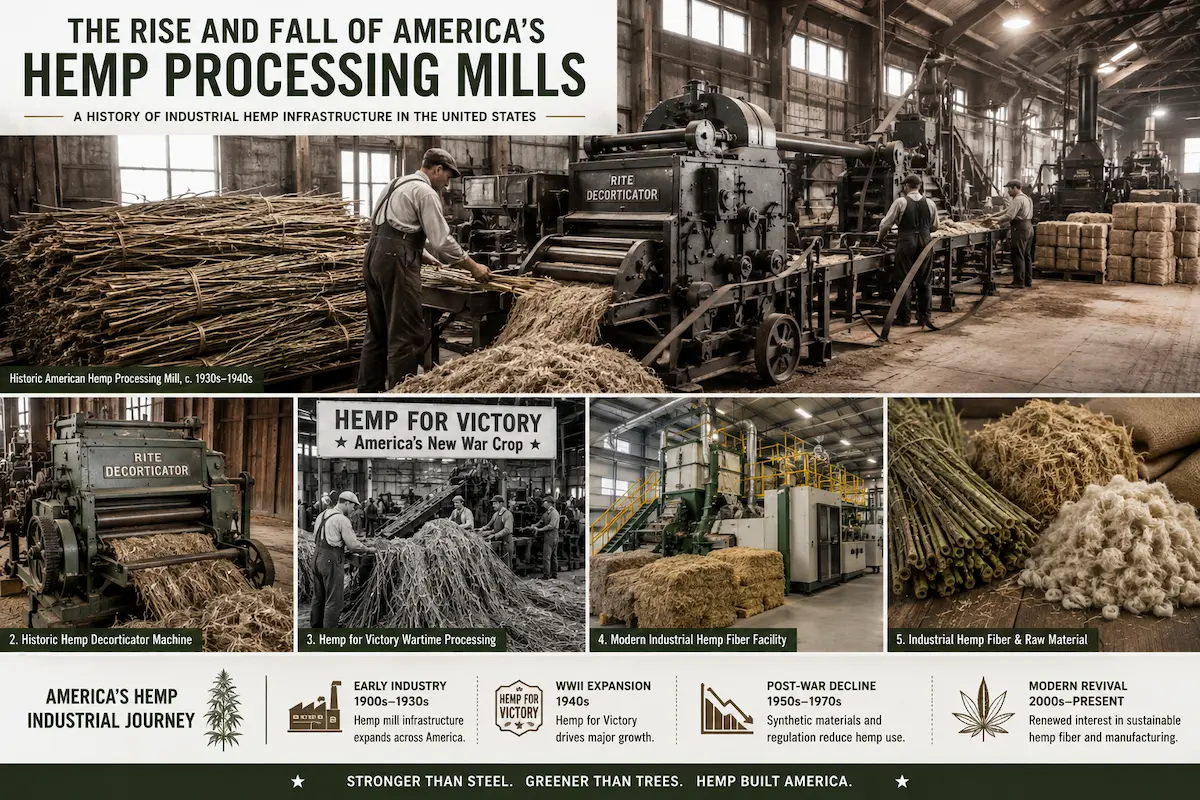
One of the most important industrial technologies in hemp processing history was the decorticator.
Decortication is the mechanical separation of hemp stalks into usable fiber and hurd materials. This process allowed industrial hemp to move into manufacturing applications such as textiles, cordage, insulation, composites, and paper production.
Without decortication infrastructure, raw hemp stalks had limited commercial utility.
Modern agricultural development groups and industrial hemp researchers continue to identify decortication capacity as one of the major structural challenges facing the hemp industry today.
The continued importance of processing infrastructure can also be seen in current discussions surrounding USDA hemp production resources and regional industrial development efforts.
WWII and the Hemp for Victory Program
During World War II, the federal government temporarily expanded support for domestic hemp production as wartime supply shortages increased demand for industrial fibers.
The “Hemp for Victory” campaign encouraged American farmers to cultivate hemp for military applications including rope, cordage, and webbing materials.
Archival wartime records preserved through the Library of Congress document how hemp became strategically important to military logistics and industrial supply systems during the war years.
Processing capacity also expanded during this period as regional infrastructure became necessary to support wartime manufacturing demand.
Programs associated with War Hemp Industries helped coordinate aspects of cultivation and industrial processing during the wartime production period.
The Postwar Collapse of Hemp Mills
The decline of America’s hemp-processing infrastructure after World War II did not occur because of a single isolated event.
Instead, multiple industrial and economic changes contributed to the contraction of the hemp sector over time.
These included:
- the rise of synthetic fibers
- changes in manufacturing economics
- increasing imports
- transportation shifts
- declining regional processing infrastructure
- evolving regulatory environments
As regional mills and decorticators disappeared, hemp cultivation became increasingly difficult to sustain economically in many parts of the country.
The loss of processing infrastructure created a long-term industrial bottleneck that continued affecting hemp production decades later.
Some explanations for the decline of America’s hemp-processing industry remain debated among historians, industry researchers, and advocacy groups.
America’s Modern Infrastructure Bottleneck
Even after modern hemp legalization reforms, infrastructure fragmentation remained one of the industry’s largest structural challenges.
Many modern hemp regions experienced situations where cultivation expanded faster than local processing capacity.
Current industrial hemp production still depends heavily on:
- nearby decortication facilities
- transportation logistics
- manufacturing partnerships
- stable supply-chain coordination
- regional processing hubs
Industry studies and agricultural reporting published through organizations including the USDA National Agricultural Statistics Service (NASS) continue tracking uneven development patterns across hemp sectors.
In many areas, processor instability and infrastructure shortages remain major limitations for industrial-scale expansion.
The 2025–2026 Hemp Industry Environment
By 2025–2026, the American hemp industry increasingly reflected a restructuring process rather than a simple revival narrative.
Modern investment activity has focused more heavily on:
- hemp fiber processing
- hempcrete manufacturing
- biocomposite materials
- industrial supply chains
- textile infrastructure
- regional manufacturing systems
At the same time, regulatory separation between industrial hemp markets and intoxicating hemp-derived cannabinoid products became more pronounced.
This distinction influenced:
- investment patterns
- state policy discussions
- processor development
- manufacturing priorities
Current hemp-processing data remains fluid as new pilot programs, regional facilities, and industrial partnerships continue emerging.
Current hemp-processing data is evolving rapidly as new facilities, pilot programs, and regional fiber initiatives continue to emerge.
Rebuilding Industrial Hemp Infrastructure
Several modern hemp initiatives now focus on rebuilding industrial processing ecosystems rather than emphasizing cultivation alone.
New investment efforts include:
- regional decortication facilities
- hempcrete material production
- natural-fiber composites
- textile-processing systems
- localized manufacturing hubs
These projects often involve partnerships between:
- universities
- agricultural cooperatives
- private manufacturers
- regional development groups
Modern industrial hemp discussions increasingly center on whether the United States can maintain stable long-term processing infrastructure capable of supporting commercial-scale manufacturing.
This shift represents a major structural change from earlier hemp conversations that focused primarily on legalization or cultivation acreage.
Historical hemp-processing records from the early and mid-20th century are incomplete in some regions, and exact mill counts or production totals may vary between sources.
Clarifications and Misinterpretations
The history of industrial hemp is sometimes simplified into single-cause narratives that do not fully reflect the complexity of industrial, economic, and regulatory changes over time.
This article does not argue that hemp disappeared because of one isolated policy decision or conspiracy-driven event.
Instead, the historical decline of hemp-processing infrastructure reflected overlapping factors including:
- industrial competition
- manufacturing shifts
- synthetic material adoption
- infrastructure contraction
- regulatory changes
- changing economic conditions
Modern industrial hemp development also differs significantly from earlier historical systems. Current infrastructure models often involve newer technologies, regional pilot projects, and modern building-material applications.
Industrial hemp infrastructure discussions are also distinct from broader cannabis legalization debates.
Structural Implications
The rise and fall of America’s hemp-processing mills demonstrates how agricultural industries depend on industrial systems beyond cultivation alone.
Processing infrastructure determines whether raw agricultural materials can move efficiently into commercial manufacturing supply chains.
Without stable:
- mills
- decorticators
- transportation systems
- manufacturing buyers
- regional processing hubs
even productive hemp cultivation can face economic limitations.
This dynamic continues shaping the modern hemp industry today.
Conclusion
America’s hemp industry was historically built on infrastructure as much as agriculture itself.
Regional mills, processing systems, decorticators, and manufacturing partnerships allowed industrial hemp to function at commercial scale for decades. When many of those systems disappeared after World War II, the broader industrial ecosystem surrounding hemp weakened as well.
Today’s hemp industry is once again confronting the importance of processing infrastructure.
As modern investment expands into hempcrete, textiles, industrial fiber, and biocomposites, long-term viability may depend less on cultivation alone and more on whether stable regional processing systems can be rebuilt and maintained across the United States.
Footer
Version: v1.1
Based on verified statutory and regulatory sources current as of May 2026.
Executive Summary
For much of American history, industrial hemp depended on more than farmland alone. The crop required a network of regional mills, decorticators, transportation systems, labor infrastructure, and manufacturing buyers capable of converting raw hemp stalks into usable industrial materials. Rope, sailcloth, textiles, cordage, and military supplies all relied on these processing systems.
The collapse of many of America’s hemp-processing mills after World War II was tied to multiple overlapping factors, including the rise of synthetic fibers, changing industrial economics, global manufacturing shifts, import competition, and evolving regulations. While hemp farming itself declined, the larger loss involved the disappearance of the infrastructure that made industrial hemp commercially viable at scale.
Today, the American hemp industry is undergoing another transition. Modern hemp processing is increasingly focused on fiber, hempcrete, biocomposites, and industrial manufacturing applications, but infrastructure fragmentation remains a major challenge. As of 2025–2026, industry discussions have shifted toward rebuilding regional processing systems rather than focusing solely on cultivation or legalization.
Verified Legal / Regulatory Foundation
Industrial hemp in the United States has historically occupied a shifting regulatory position tied to agricultural policy, controlled substance laws, wartime production programs, and more recent federal hemp legislation.
During World War II, the federal government temporarily encouraged domestic hemp cultivation through the “Hemp for Victory” campaign to support military supply needs, particularly rope and cordage production. The program operated alongside wartime processing expansion and regional industrial coordination.
Modern hemp regulation changed significantly following the passage of the 2018 Farm Bill, which federally distinguished hemp from marijuana based primarily on THC concentration thresholds. Since then, federal and state agencies have continued refining rules related to cultivation, processing, transportation, and hemp-derived cannabinoid products.
By 2025–2026, the regulatory landscape increasingly reflected a separation between industrial hemp sectors — including fiber and grain production — and intoxicating hemp-derived cannabinoid markets. This separation has affected investment patterns, processing infrastructure priorities, and regional development strategies.
The legal distinction between hemp and marijuana has evolved significantly over time and remains subject to ongoing federal and state regulatory changes, especially regarding THC thresholds, hemp-derived cannabinoids, and intoxicating hemp products.
Confirmed Facts
Hemp Was Historically an Industrial Crop
Before synthetic materials became dominant, hemp served as a major industrial agricultural commodity in multiple sectors. Hemp fiber was used in rope, sailcloth, canvas, cordage, textiles, and military supply systems because of its durability and resistance to saltwater deterioration.
Naval operations historically depended heavily on hemp rope and rigging materials. In both commercial shipping and military logistics, hemp was considered strategically useful due to the material demands of maritime trade and warfare.
Industrial hemp production depended on a coordinated supply chain rather than farming alone. Farmers grew hemp, but regional mills and processors transformed the harvested stalks into usable commercial materials.
The Role of Hemp Processing Mills
Hemp-processing mills acted as the industrial backbone of the hemp economy. One of the most important stages in this system involved decortication — the mechanical separation of the hemp stalk into usable fiber and hurd components.
Decorticators allowed processors to prepare hemp for industrial manufacturing applications, including textiles, rope production, insulation materials, paper inputs, and later industrial composites.
Because hemp stalks are bulky and expensive to transport long distances before processing, regional mill networks were historically important. Farmers often depended on nearby processing facilities to make cultivation economically practical.
This infrastructure dependency meant that even when farmers could grow hemp successfully, the absence of processing capacity could limit the crop’s commercial usefulness.
World War II and “Hemp for Victory”
During World War II, wartime shortages and military supply demands increased federal support for domestic hemp production. The federal government promoted hemp cultivation through the “Hemp for Victory” campaign, encouraging farmers to grow hemp for military and industrial use.
Processing capacity expanded during this period as wartime demand increased the need for rope, webbing, cordage, and related military materials. Regional processing systems became strategically important components of wartime agricultural production.
War Hemp Industries and related programs helped coordinate aspects of processing and supply infrastructure during the wartime expansion phase.
The Postwar Decline
The decline of America’s hemp-processing infrastructure did not occur because of a single event or isolated policy change. Multiple industrial and economic pressures contributed to the contraction of the sector after World War II.
The growing use of synthetic fibers reduced industrial demand for traditional natural-fiber materials. Global manufacturing shifts and imports also altered textile and industrial supply chains over time. At the same time, broader regulatory changes surrounding cannabis affected cultivation and processing environments.
As processing mills closed, regional infrastructure networks weakened. Once local decorticators and processing hubs disappeared, hemp cultivation became more difficult to sustain economically in many regions.
Some explanations for the decline of America’s hemp-processing industry remain debated among historians, industry researchers, and advocacy groups.
The Infrastructure Continuity Problem
One of the recurring challenges in the modern hemp industry has been the lack of stable processing continuity. Even after federal hemp legalization reforms in recent years, many regions continued facing infrastructure bottlenecks.
Modern fiber hemp production still depends heavily on:
- nearby processing facilities
- transportation logistics
- decortication equipment
- manufacturing buyers
- stable supply-chain coordination
In some regions, farmers expanded cultivation before sufficient processing systems existed. This created situations where harvested hemp had limited nearby industrial outlets.
Industry analysts and agricultural development groups have repeatedly identified decortication shortages and fragmented processing systems as major barriers to scaling industrial hemp production in the United States.
The 2025–2026 Industry Environment
By 2025–2026, the American hemp sector increasingly reflected a restructuring process rather than a simple “industry revival.”
USDA and regional industry data during this period showed uneven growth patterns across hemp sectors. Fiber and industrial-material applications gained attention in several states, while cannabinoid-related hemp markets faced ongoing regulatory uncertainty and processor instability.
The separation between industrial hemp infrastructure and intoxicating hemp-derived product markets also became more pronounced in policy discussions and investment strategies.
Modern investment efforts increasingly focused on:
- regional fiber-processing hubs
- industrial hemp manufacturing
- hempcrete materials
- textile applications
- biocomposite supply chains
- agricultural processing partnerships
Current hemp-processing data is evolving rapidly as new facilities, pilot programs, and regional fiber initiatives continue to emerge.
Modern Rebuilding Efforts
Several modern hemp initiatives now focus on rebuilding industrial processing capacity rather than emphasizing cultivation alone.
Hempcrete construction materials, natural-fiber composites, textile manufacturing, insulation systems, and industrial fiber applications have all contributed to renewed interest in regional processing infrastructure.
Universities, private manufacturers, agricultural cooperatives, and regional development groups have explored:
- localized decortication facilities
- fiber aggregation systems
- industrial hemp processing corridors
- manufacturing partnerships
- supply-chain standardization
Supporters of industrial hemp development often argue that long-term viability depends less on raw acreage totals and more on whether stable processing and manufacturing ecosystems can be maintained.
Historical hemp-processing records from the early and mid-20th century are incomplete in some regions, and exact mill counts or production totals may vary between sources.
Clarifications / Misinterpretations
The history of hemp processing in the United States is sometimes simplified into single-cause explanations that do not fully reflect the complexity of industrial and regulatory changes over time.
The decline of hemp-processing infrastructure involved multiple overlapping factors, including:
- industrial competition
- synthetic material adoption
- changing transportation economics
- manufacturing shifts
- import pressures
- regulatory changes
- infrastructure contraction
Modern industrial hemp development also should not be viewed as a direct recreation of earlier historical systems. Current processing models often involve newer technologies, regional pilot programs, modern building-material applications, and updated manufacturing standards.
Similarly, industrial hemp infrastructure discussions are distinct from broader cannabis legalization debates. Much of the current infrastructure conversation focuses on fiber processing, industrial materials, agricultural logistics, and manufacturing supply chains.
Structural Implications
The history of America’s hemp-processing mills demonstrates how agricultural industries depend on broader industrial systems beyond cultivation alone.
Processing infrastructure determines whether raw agricultural materials can move efficiently into manufacturing supply chains. Without stable regional mills, transportation systems, decorticators, and commercial buyers, even productive hemp cultivation can face economic limitations.
This dynamic continues shaping the modern hemp industry. As states and private companies explore hemp-based construction materials, textiles, composites, and industrial applications, processing capacity remains one of the central structural challenges.
The long-term viability of industrial hemp in the United States may depend less on acreage expansion and more on whether durable regional processing ecosystems can be established and maintained.
Conclusion
America’s hemp industry was historically built on processing infrastructure as much as agriculture itself. Regional mills, decorticators, transportation systems, and industrial manufacturing relationships made large-scale hemp production commercially possible for decades.
The decline of many of those systems after World War II reflected broader industrial restructuring rather than a single isolated cause. As mills disappeared, the supporting infrastructure behind industrial hemp weakened as well.
Today’s hemp industry faces a similar structural question. Modern interest in hempcrete, industrial fiber, textiles, and biocomposites has renewed attention on processing systems and regional manufacturing capacity. But the long-term success of industrial hemp may ultimately depend on whether stable processing infrastructure can be rebuilt at scale.
Footer
Version: v1.0
Based on verified statutory and regulatory sources current as of May 2026.