
Executive Summary
Industrial hemp is a legally defined variety of Cannabis sativa L. that contains no more than 0.3% delta-9 THC on a dry-weight basis under U.S. federal law. Although hemp and marijuana come from the same plant species, they are treated differently under federal regulations because of their THC content.
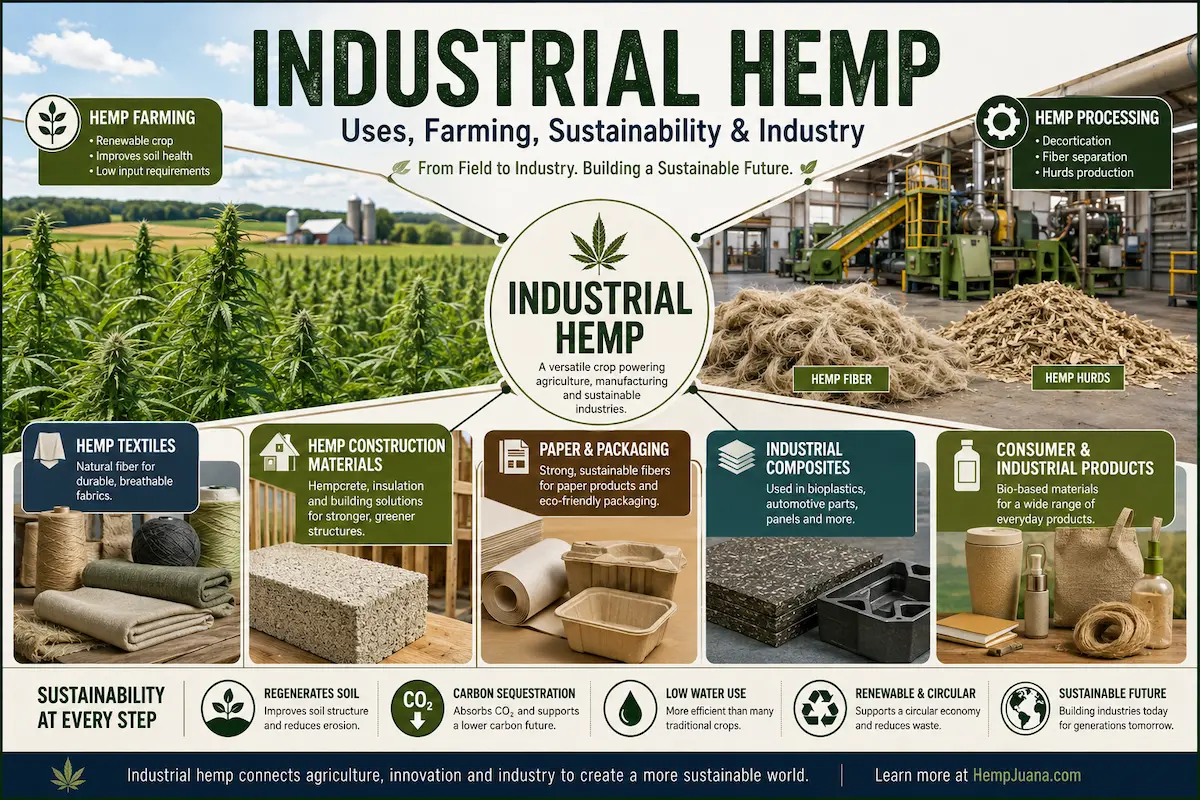
Today, industrial hemp is used in industries ranging from textiles and construction to food production and advanced manufacturing. Interest in hemp has grown as farmers, manufacturers, researchers, and policymakers explore its role in modern agriculture, sustainable materials, and domestic manufacturing.
This guide explains what industrial hemp is, how it is grown and processed, its major industrial applications, sustainability considerations, economic realities, regulatory framework, and the opportunities and challenges shaping the industry’s future.
Table of Contents
Editorial Update (June 2026):
This article serves as the foundational Industry & Business pillar within HempJuana’s Semantic Knowledge Ecosystem (HSKE). It has been developed using verified regulatory, agricultural, and industry sources to provide readers with an educational overview of industrial hemp and its role in modern agriculture, manufacturing, and emerging industrial markets.
What Is Industrial Hemp?
Industrial hemp is a federally defined form of Cannabis sativa L. containing no more than 0.3% delta-9 THC on a dry-weight basis.
This legal distinction separates hemp from marijuana under federal law. While both belong to the same plant species, industrial hemp is cultivated primarily for fiber, grain, hurd, and industrial applications rather than intoxicating effects.
The modern federal framework for hemp was established by the 2018 Farm Bill, which legalized hemp production under approved regulatory programs.
Industrial hemp serves as a raw material for numerous industries, including manufacturing, agriculture, construction, food production, textiles, composites, and emerging sustainable materials development. To understand how hemp became legally distinct from marijuana in the United States, readers may also explore:
Hemp vs. Marijuana Under Federal Law
Cannabis Policy and Law in the United States
For official federal guidance, readers can review the USDA Hemp Program:
https://www.ams.usda.gov/rules-regulations/hemp
A Brief History of Industrial Hemp
As historical background, hemp has been cultivated for thousands of years for fiber, rope, textiles, paper, and other practical uses.
In the United States, hemp once played an important role in agriculture and manufacturing. Over time, changing regulations, industrial competition, and market conditions contributed to a decline in domestic hemp production. The rise and fall of domestic hemp manufacturing played a significant role in the industry’s history. Readers interested in this topic can explore Hemp Processing History: Rise and Fall of U.S. Mills.
Interest in industrial hemp reemerged during the twenty-first century, culminating in the passage of the 2018 Farm Bill and the creation of the current regulatory framework.
Today, hemp is once again being explored for agricultural, manufacturing, and industrial applications across the United States.
How Industrial Hemp Is Grown
Industrial hemp can be cultivated for several primary purposes:
- Fiber production
- Grain production
- Dual-purpose production
Growing methods vary depending on the intended end use.
Farmers typically select hemp varieties based on climate, soil conditions, regional regulations, and market demand. Fiber crops are generally managed differently than grain-focused crops, and harvesting methods may vary accordingly.
Industrial hemp is often discussed as a versatile crop, but production outcomes can differ significantly depending on weather conditions, processing access, local infrastructure, and available markets.
Future Reading:
- Hemp Farming and Cultivation (Coming Soon)
Industrial Hemp Processing Explained
Growing hemp is only one step in the industrial supply chain. Processing is often where significant challenges emerge.
Fiber hemp typically requires decortication, a process that separates the plant’s outer bast fiber from its inner woody hurd. These materials can then be refined for textiles, composites, insulation products, and construction materials.
Grain hemp follows a different processing pathway involving cleaning, sorting, storage, and preparation for food-related uses.
One of the most frequently discussed barriers to industry growth is limited processing infrastructure. Many regions have farmers capable of growing hemp but lack nearby facilities to process harvested material efficiently.
As a result, processing capacity remains one of the most important factors influencing the long-term growth of the industrial hemp sector.
Related Reading:
- Hemp Processing History: Rise and Fall of U.S. Mills (Insert Published URL)
- Hemp Processing and Decortication Explained (Coming Soon)
Major Uses of Industrial Hemp
Fiber and Textiles
Hemp fiber can be used in textiles, industrial fabrics, rope, composites, insulation products, and specialty manufacturing applications.
Interest in hemp fiber has increased as manufacturers explore alternative natural fibers and domestic supply-chain opportunities.
Future Reading:
- Hemp Fiber and Textile Manufacturing (Coming Soon)
Construction Materials and Hempcrete
Hemp hurd can be incorporated into hempcrete, an emerging construction material used in certain building applications.
Hempcrete has generated interest within sustainable construction discussions because of its unique properties. However, it should not be viewed as a direct replacement for conventional concrete in every application. Suitability depends on project requirements, building codes, and local availability.
Future Reading:
- Hemp Construction Materials and Hempcrete (Coming Soon)
Paper and Packaging
Hemp fiber has historically been used in paper production and continues to be explored for specialty paper and packaging applications.
Commercial adoption varies by market, economics, and manufacturing infrastructure.
Bioplastics and Composite Materials
Industrial hemp is used in some composite materials and is being studied for applications involving bioplastics and alternative manufacturing materials.
While hemp-based bioplastics represent a promising area of development, they remain an emerging industry sector rather than a widely adopted mainstream manufacturing solution.
Food and Grain Products
Hemp grain can be processed into food ingredients including:
- Hemp seeds
- Hemp oil
- Hemp protein products
- Nutritional food ingredients
These products represent an important segment of the broader industrial hemp marketplace.
Industrial Hemp and Sustainability
Interest in industrial hemp is often connected to broader sustainability discussions.
Researchers, businesses, and policymakers continue studying topics such as:
- Resource efficiency
- Agricultural diversification
- Carbon-related impacts
- Alternative materials
- Soil management considerations
However, sustainability claims should be evaluated carefully.
Industrial hemp is sometimes promoted as a solution to environmental challenges, but outcomes depend on farming practices, geography, processing methods, transportation requirements, and product life cycles.
Similarly, claims that hemp always improves soil or is universally carbon negative should be approached cautiously. Current evidence suggests potential benefits in certain contexts, but results are not guaranteed across all situations.
Future Reading:
- Hemp Sustainability and Environmental Impact (Coming Soon)
- Hemp Soil Health Benefits (Coming Soon)
- Hemp and Carbon Sequestration (Coming Soon)
For research access:
The Economics of Industrial Hemp
Industrial hemp supports multiple supply chains that connect agriculture, processing, manufacturing, transportation, and retail markets.
Potential opportunities may include:
- Fiber production
- Grain production
- Value-added manufacturing
- Construction materials
- Specialty products
At the same time, profitability varies significantly by region, infrastructure availability, market demand, production costs, and processing access.
As with most agricultural industries, economic outcomes can differ substantially from one operation to another.
Future Reading:
- Industrial Hemp Economics (Coming Soon)
Industrial Hemp Regulations in the United States
Federal law defines hemp as Cannabis sativa L. containing no more than 0.3% delta-9 THC on a dry-weight basis.
The 2018 Farm Bill established the modern federal hemp framework and expanded opportunities for legal cultivation under approved programs.
Additional federal information can be reviewed here:
- USDA Hemp Program:
https://www.ams.usda.gov/rules-regulations/hemp - USDA National Agricultural Statistics Service:
https://www.nass.usda.gov - 2018 Farm Bill:
https://www.congress.gov/bill/115th-congress/house-bill/2
States may participate through federally approved programs and may implement additional requirements consistent with applicable regulations.
This article is intended for informational purposes only and should not be considered legal advice.
Challenges Facing the Hemp Industry
Despite growing interest, the hemp industry continues to face several challenges:
- Limited processing infrastructure
- Supply-chain development needs
- Investment requirements
- Market uncertainty
- Regulatory complexity
Infrastructure remains one of the most frequently discussed barriers to growth. Expanding cultivation alone may not be sufficient without corresponding investments in processing, transportation, manufacturing, and market development.
Industry growth often depends on coordinated development across multiple sectors.
The Future of Industrial Hemp
Many stakeholders view industrial hemp as a crop with significant long-term potential.
Areas receiving continued attention include:
- Domestic manufacturing
- Advanced materials
- Sustainable construction products
- Fiber processing expansion
- Supply-chain development
- Emerging industrial applications
At the same time, future growth is not guaranteed. Market adoption, infrastructure investment, regulatory developments, and economic conditions will continue influencing the industry’s trajectory.
Industrial hemp’s future will likely be shaped by both opportunities and practical challenges.
Continue Exploring Industrial Hemp
Industrial hemp spans agriculture, manufacturing, sustainability, and business development. Readers interested in learning more may wish to explore the following resources:
- Hemp Processing History: Rise and Fall of U.S. Mills
- Hemp Farming and Cultivation (Coming Soon)
- Hemp Processing and Decortication Explained (Coming Soon)
- Hemp Sustainability and Environmental Impact (Coming Soon)
- Hemp Soil Health Benefits (Coming Soon)
- Hemp and Carbon Sequestration (Coming Soon)
- Hemp Fiber and Textile Manufacturing (Coming Soon)
- Hemp Construction Materials and Hempcrete (Coming Soon)
- Industrial Hemp Economics (Coming Soon)
Conclusion
Industrial hemp occupies a unique position at the intersection of agriculture, manufacturing, sustainability, and business.
Legally distinct from marijuana under federal law, hemp can be cultivated for fiber, grain, hurd, and a variety of industrial applications. Interest in hemp continues to grow as industries explore new materials, manufacturing opportunities, and agricultural markets.
However, challenges involving infrastructure, processing capacity, regulation, and market development remain important considerations.
As the industry evolves, industrial hemp is expected to remain a topic of interest for farmers, manufacturers, entrepreneurs, researchers, and consumers seeking to better understand its role in the modern economy.
Footer
Version: v1.0
Based on verified statutory and regulatory sources current as of June 2026.
Editorial Note
This article is provided for informational and educational purposes only. It is based on publicly available sources and verified regulatory information available at the time of publication. It should not be considered legal, financial, agricultural, or professional advice. Readers should conduct their own research and consult qualified professionals before making business, farming, investment, or regulatory decisions.