
Executive Summary
Industrial hemp soil health research has gained increasing attention as farmers, researchers, and policymakers explore more sustainable approaches to agriculture. Hemp can provide measurable soil-health benefits, but it is not a miracle crop capable of solving every farming challenge on its own.
Current evidence suggests hemp may help improve soil structure, contribute organic matter, suppress weeds through dense canopy growth, support crop rotation diversity, and reduce certain forms of soil erosion. These characteristics have made hemp a frequent topic in discussions about sustainable farming and regenerative agriculture.
At the same time, some environmental claims surrounding hemp have been overstated. Research into soil biodiversity, microbial activity, carbon sequestration, and long-term ecosystem impacts remains ongoing. While many findings are promising, researchers continue studying how hemp performs across different climates, soil types, and production systems.
The strongest benefits appear when hemp is incorporated into a broader soil-management strategy that includes practices such as crop rotation, erosion control, nutrient management, reduced tillage, and conservation planning.
Readers seeking a broader overview of industrial hemp may also explore:
Industrial Hemp: A Complete Guide
https://hempjuana.com/industrial-hemp-guide/
Understanding both the strengths and limitations of hemp helps farmers and landowners make informed decisions based on current evidence rather than marketing claims.
Table of Contents
What Makes Hemp Different From Other Crops?
Industrial hemp is an annual crop cultivated for fiber, grain, cannabinoids, and other industrial uses. Compared with many conventional row crops, hemp often develops a dense canopy quickly and produces extensive root systems that interact with the soil throughout the growing season.
Many varieties grow rapidly and generate significant biomass in a relatively short period. Depending on genetics and growing conditions, hemp can reach several feet in height while producing substantial root development below ground.
These characteristics contribute to many of the soil-health discussions surrounding hemp cultivation. However, benefits vary based on local conditions, management practices, crop variety, and overall farm goals.
Hemp should therefore be viewed as one potential tool within a larger agricultural system rather than a universal solution.
Why Some Agricultural Soils Become Degraded
Healthy soil develops over long periods of time, but degradation can occur much more quickly when environmental and management pressures accumulate.
Several factors commonly contribute to declining soil quality.
Monocropping
Growing the same crop repeatedly on the same land may reduce biological diversity and create recurring demands on specific nutrients. Over time, this can increase vulnerability to pests, disease pressures, and nutrient imbalances.
Intensive Tillage
Frequent tillage can disturb soil structure, increase exposure to erosion, and accelerate the breakdown of organic matter.
Soil Compaction
Heavy equipment traffic may compress soil particles, reducing pore space needed for air movement, water infiltration, and healthy root growth.
Organic Matter Loss
Organic matter supports water retention, nutrient cycling, and biological activity. When organic matter declines, soil performance often declines as well.
Erosion
Wind and water can remove valuable topsoil, reducing long-term agricultural productivity.
Nutrient Depletion
Crop production removes nutrients from the soil. Without proper nutrient management, fertility levels may gradually decline.
The principles of soil conservation, erosion management, and soil-health improvement are discussed extensively by the USDA Natural Resources Conservation Service (NRCS):
Because soil degradation develops through multiple causes, improvement typically requires multiple management strategies rather than reliance on a single crop.
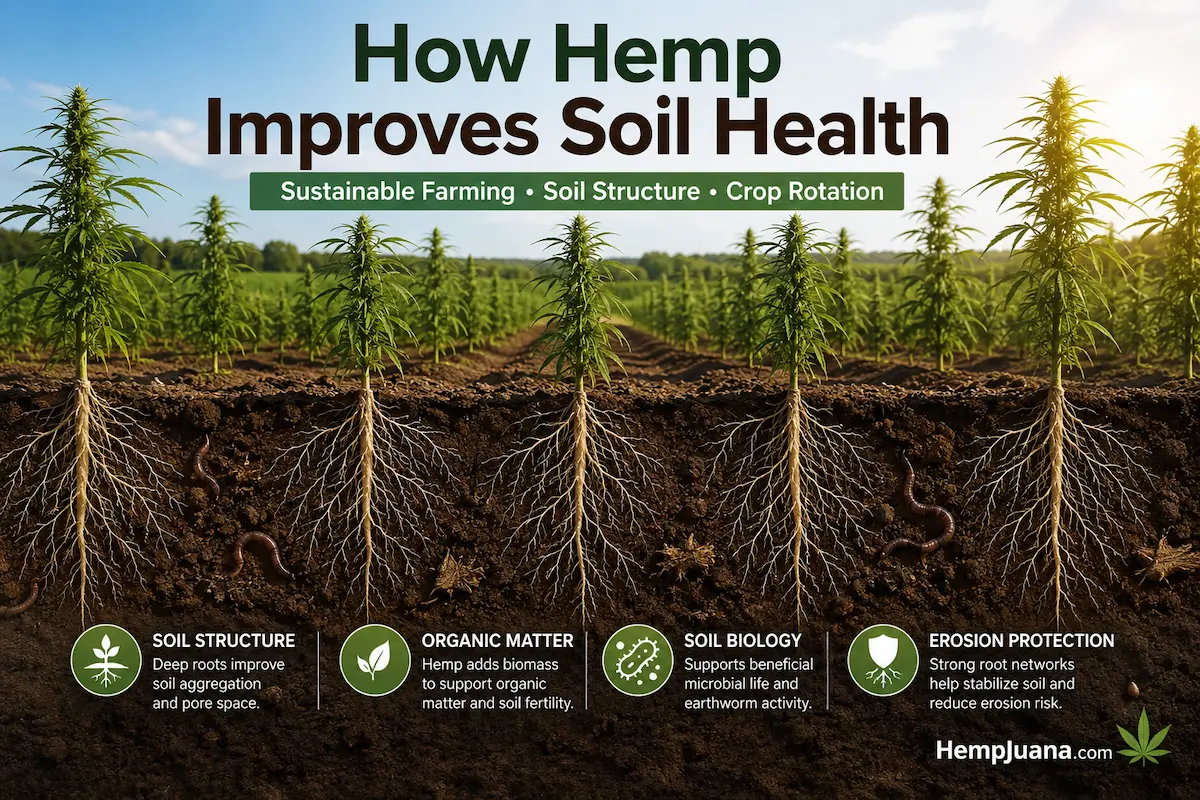
How Hemp Improves Soil Structure
One reason industrial hemp soil health research has attracted attention is the crop’s potential influence on soil structure.
Soil structure refers to how mineral particles, organic matter, air, and water are organized within the soil profile. Healthy soil structure supports root development, water infiltration, and biological activity.
Hemp roots can penetrate the soil while creating channels that may improve water movement and root access for future crops. Above-ground plant residues may also contribute organic material that supports soil aggregation.
Improved aggregation can help:
- Increase water infiltration
- Reduce surface runoff
- Improve root penetration
- Support long-term soil stability
The extent of these benefits depends heavily on local conditions and management practices, but research generally supports hemp’s ability to contribute positively to soil structure.
Deep Root Systems and Soil Aeration
Many hemp varieties develop relatively deep and extensive root systems compared with some annual crops.
As roots grow through the soil profile, they create pathways that may:
- Improve soil aeration
- Enhance water infiltration
- Reduce localized compaction
- Support future root development
When roots decompose after harvest, many of these channels remain in the soil. Future crops may benefit from these pathways, allowing roots and soil organisms easier access through the profile.
Although hemp cannot eliminate severe compaction by itself, its root systems may contribute to healthier soil conditions when combined with broader soil-management practices.
This is one reason hemp is frequently discussed within sustainable agriculture systems focused on long-term soil improvement.
Hemp and Soil Organic Matter
Soil organic matter is widely recognized as one of the most important indicators of soil health.
Organic matter helps support:
- Water retention
- Nutrient cycling
- Soil structure stability
- Microbial activity
- Long-term productivity
Hemp can contribute organic material through roots, leaves, stalk residues, and other plant tissues that remain after harvest.
Over time, portions of this biomass may become incorporated into the soil, contributing to organic matter levels. The actual amount retained depends on numerous factors, including:
- Harvest methods
- Residue management
- Climate conditions
- Soil biology
- Decomposition rates
Educational resources from the University of Minnesota Extension provide additional information on soil organic matter, nutrient cycling, and sustainable crop management:
Current evidence supports hemp’s ability to contribute organic materials to agricultural soils, although long-term outcomes remain dependent on overall farm management.
Can Hemp Reduce Soil Erosion?
Erosion remains one of the most significant threats to agricultural productivity worldwide.
Wind and water can gradually remove valuable topsoil, reducing fertility and limiting long-term crop performance.
Hemp may help reduce erosion through several mechanisms:
- Rapid canopy development
- Increased soil coverage
- Root systems that help stabilize soil
- Reduced exposure of bare ground during active growth
Fields with greater vegetative cover are often less vulnerable to erosion than exposed soil surfaces.
However, hemp does not eliminate erosion risks entirely. Factors such as rainfall intensity, slope, soil type, wind exposure, and management practices continue to play major roles in erosion outcomes.
For this reason, hemp should be viewed as one component of a broader soil-conservation strategy rather than a complete erosion-control solution.
Weed Suppression Benefits of Hemp
One of hemp’s most frequently cited agricultural advantages is its ability to compete with weeds during the growing season.
Many hemp varieties establish quickly and develop dense canopies that limit the amount of sunlight reaching the soil surface. Reduced sunlight can make it more difficult for some weed species to thrive.
Potential weed-suppression benefits may include:
- Reduced weed competition
- Lower weed pressure during active growth
- Improved field coverage
- Additional crop-management flexibility
The effectiveness of weed suppression depends on several factors, including:
- Planting density
- Variety selection
- Soil conditions
- Weather patterns
- Existing weed populations
Hemp should not be viewed as a complete replacement for integrated weed-management programs. Instead, it may serve as a useful component within broader weed-control strategies.
As with many agricultural practices, results vary from farm to farm.
Hemp’s Role in Crop Rotation Systems
Crop rotation has long been recognized as one of the most effective tools for maintaining productive agricultural soils.
Rotating crops helps diversify biological activity, reduce repetitive nutrient demands, and interrupt certain pest and disease cycles.
When included within a rotation system, hemp may offer several potential advantages:
- Increased crop diversity
- Different rooting patterns compared with other crops
- Additional biomass production
- Weed-management support
- Reduced monocropping pressures
Many agronomists view diversity as a key principle of sustainable agriculture. By introducing a different crop into an established rotation, farmers may create opportunities for improved soil management and long-term resilience.
Research continues to evaluate the specific benefits of hemp within various rotational systems, but current evidence generally supports its value as a rotational crop rather than a stand-alone solution.
Soil Biodiversity and Microbial Activity
Healthy soil contains diverse communities of organisms, including:
- Bacteria
- Fungi
- Earthworms
- Insects
- Protozoa
- Other microscopic life forms
Together, these organisms contribute to nutrient cycling, organic matter decomposition, and overall soil function.
Researchers continue studying how hemp influences soil biodiversity and microbial activity.
Current evidence suggests hemp may contribute to beneficial biological activity through:
- Root exudates
- Organic matter contributions
- Root-zone interactions
- Reduced disturbance in certain production systems
However, the relationship between hemp and soil biology remains an active area of scientific research.
Research is promising, but long-term evidence remains limited.
Soil microbial communities are influenced by numerous factors beyond crop selection alone, including climate, management practices, fertility programs, and soil characteristics.
For this reason, hemp should not be viewed as a guaranteed method of increasing soil biodiversity. Instead, current evidence suggests it may contribute positively within well-managed agricultural systems.
Can Hemp Remove Heavy Metals From Soil?
One of the most discussed environmental applications of hemp involves a process known as phytoremediation.
Phytoremediation refers to the use of plants to absorb, stabilize, or interact with contaminants present in soil.
Researchers have found that hemp can absorb certain contaminants, including some heavy metals, under specific conditions.
Examples may include:
- Cadmium
- Lead
- Nickel
- Other heavy metals
Important Clarification
Hemp can absorb certain contaminants, including some heavy metals, through a process known as phytoremediation. However, these contaminants do not disappear. Instead, they may accumulate within the plant’s tissues. As a result, hemp grown on contaminated land may face restrictions on how the harvested material can be used, processed, or disposed of.
This distinction is important because phytoremediation is sometimes misunderstood as a complete cleanup solution.
In reality:
- Contaminants remain present
- Plant material may require special handling
- Regulatory restrictions may apply
- Remediation projects can take years
Researchers continue studying phytoremediation and contaminant uptake in agricultural systems. Additional research resources can be found through the USDA Agricultural Research Service (ARS):
Current evidence supports hemp’s potential role in certain remediation projects, but it does not support claims that hemp completely cleans contaminated land.
Carbon Sequestration and Climate Benefits
Carbon sequestration refers to the capture and storage of carbon within plants, soils, and other environmental systems.
Because hemp grows rapidly and produces substantial biomass, researchers have explored its potential contributions to carbon management.
Potential benefits may include:
- Carbon storage in plant biomass
- Soil carbon inputs through roots
- Carbon retained in certain long-lived hemp products
- Reduced soil disturbance in some production systems
Current evidence suggests hemp may contribute to carbon-management strategies, but the overall magnitude of these benefits remains under investigation.
The amount of carbon ultimately stored depends on numerous variables, including:
- Farming practices
- Soil conditions
- Climate
- Harvest methods
- Product end use
- Residue management
Penn State Extension offers educational resources covering sustainable agriculture, soil conservation, and carbon-management practices:
While hemp shows promise in this area, current evidence does not support claims that hemp alone can solve climate-related challenges or serve as a singular carbon solution.
Researchers continue studying how hemp compares with other agricultural crops and land-management practices in long-term carbon sequestration efforts.
Does Hemp Fix Soil or Help Manage Soil Health?
This distinction is one of the most important concepts in discussions about industrial hemp soil health.
Hemp can help support soil-health management, but it does not automatically repair degraded soils or reverse years of poor land management on its own.
Many of the positive characteristics associated with hemp—including root development, organic matter contributions, weed suppression, and erosion management—can support healthier agricultural systems. However, these benefits work best when combined with broader conservation practices.
What Hemp Can Do
Current evidence suggests hemp may help:
- Improve soil structure
- Contribute organic matter
- Support crop diversity
- Assist with erosion management
- Suppress certain weeds
- Contribute to healthier root-zone conditions
- Support sustainable crop-rotation programs
What Hemp Cannot Do
Current evidence does not support claims that hemp can:
- Restore all depleted nutrients automatically
- Reverse severe soil degradation by itself
- Eliminate soil compaction in every situation
- Replace fertility-management programs
- Completely clean contaminated land
- Eliminate erosion under all conditions
The most accurate way to describe hemp is as a potentially valuable management tool within a larger soil-health strategy.
Successful soil improvement typically requires multiple practices working together, including crop rotation, conservation planning, nutrient management, erosion control, and responsible land stewardship.
Common Myths About Hemp and Soil Health
As hemp has grown in popularity, several misconceptions have become widespread.
Understanding what current research actually supports helps separate realistic expectations from marketing claims.
Myth: Hemp Fixes All Soil Problems
Reality:
No single crop can solve every soil-health challenge.
Soil quality depends on a complex interaction of physical, biological, environmental, and management factors. Hemp may contribute positively, but it is not a universal solution.
Myth: Hemp Restores Nutrients Automatically
Reality:
Like all crops, hemp absorbs nutrients from the soil during growth.
While hemp residues may contribute organic matter, nutrient management remains necessary for productive farming systems.
Myth: Hemp Requires No Fertilizer
Reality:
Hemp can require significant nutrient inputs depending on production goals, soil conditions, variety selection, and expected yields.
Well-managed fertility programs remain important for successful hemp production.
Myth: Hemp Completely Cleans Contaminated Land
Reality:
Research supports hemp’s ability to absorb certain contaminants through phytoremediation.
However, contaminants do not disappear. Instead, they may accumulate within plant tissues and require responsible management.
Myth: Hemp Alone Creates Regenerative Agriculture
Reality:
Regenerative agriculture is based on systems and management practices, not a single crop.
Hemp may contribute to regenerative systems, but it does not automatically make an operation regenerative.
Potential Limitations Farmers Should Know
Although hemp offers potential benefits, farmers should also understand its limitations.
Like any agricultural crop, hemp presents both opportunities and challenges.
Nutrient Requirements
Productive hemp crops require nutrients.
Depending on production goals, hemp may require management of:
- Nitrogen
- Phosphorus
- Potassium
- Secondary nutrients
- Micronutrients
Nutrient demands vary based on soil conditions, climate, genetics, and intended harvest use.
Climate Limitations
Hemp performance can vary significantly across growing regions.
Factors that may influence production include:
- Temperature
- Rainfall
- Humidity
- Day length
- Growing-season duration
Not every hemp variety performs equally well in every environment.
Management Requirements
Successful hemp production requires planning and active management.
Farmers may need to consider:
- Variety selection
- Soil preparation
- Weed management
- Harvest timing
- Regulatory compliance
- Market access
Hemp should not be viewed as a low-effort crop.
Yield Variability
Agricultural production is influenced by weather, pests, diseases, management practices, and environmental conditions.
As a result, hemp yields can vary considerably from year to year.
This variability is one reason why economic planning remains important when evaluating hemp as part of a farming operation.
Market Considerations
While this article focuses on soil health, economic realities also affect adoption decisions.
Markets for fiber, grain, and cannabinoid production continue to evolve. Availability of processing infrastructure, transportation, and buyers may influence whether hemp is a practical option for a particular region.
Is Hemp a Regenerative Agriculture Crop?
Hemp is frequently discussed within regenerative agriculture conversations, but the relationship deserves careful examination.
Regenerative agriculture generally refers to farming systems designed to support long-term soil health, ecosystem function, biodiversity, and resource conservation.
Certain characteristics of hemp may align with regenerative principles, including:
- Crop diversity
- Extensive root systems
- Soil-cover benefits
- Organic matter contributions
- Potential erosion-management benefits
These characteristics may allow hemp to play a supportive role within regenerative systems.
However, hemp alone does not create regenerative agriculture.
Most regenerative farming systems rely on multiple practices working together, such as:
- Crop rotation
- Cover cropping
- Reduced tillage
- Soil-health monitoring
- Nutrient management
- Conservation planning
- Integrated livestock systems in some operations
For this reason, many researchers and agricultural professionals consider hemp best described as a crop that can contribute to regenerative agriculture rather than define it.
A balanced interpretation of current evidence suggests that hemp may be a useful component of regenerative farming strategies, but its effectiveness depends largely on how it is integrated into the overall management system.
When viewed in this context, hemp becomes part of a broader conversation about sustainable agriculture rather than a stand-alone solution.Frequently Asked Questions
Does hemp improve soil health?
Current research suggests hemp may improve certain soil-health indicators, including soil structure, organic matter contributions, weed suppression, crop-rotation diversity, and erosion management. The extent of these benefits depends on local conditions and management practices.
Is hemp good for crop rotation?
Many agricultural researchers and farmers view hemp as a useful rotational crop because it introduces diversity into cropping systems and may help reduce some of the challenges associated with continuous monocropping.
Can hemp reduce erosion?
Hemp may help reduce certain forms of erosion through rapid canopy development, soil coverage, and root growth. However, it does not eliminate erosion risks entirely and works best alongside broader conservation practices.
Does hemp require fertilizer?
Yes. Hemp typically requires nutrients for productive growth. Fertility needs vary based on soil conditions, climate, production goals, and crop variety.
Can hemp clean contaminated soil?
Hemp may absorb certain contaminants through phytoremediation, including some heavy metals. However, contaminants do not disappear and may accumulate within plant tissues, creating restrictions on how harvested biomass can be used or disposed of.
Is hemp a regenerative agriculture crop?
Hemp can contribute to regenerative agriculture systems, but it is not regenerative agriculture by itself. Regenerative outcomes typically result from multiple management practices working together over time.
Conclusion
Industrial hemp soil health research suggests the crop can provide meaningful benefits when incorporated into well-managed agricultural systems. Evidence supports hemp’s ability to contribute to soil structure, organic matter inputs, weed suppression, crop-rotation diversity, and erosion management.
At the same time, hemp should not be viewed as a miracle crop. Current research does not support claims that hemp restores all nutrients, completely cleans contaminated land, eliminates the need for fertilizers, or single-handedly creates regenerative agriculture.
The strongest conclusion from current evidence is that hemp may serve as a valuable tool within broader soil-health and sustainable-farming strategies. When combined with sound management practices, industrial hemp can contribute to healthier and more resilient agricultural landscapes.
For farmers, landowners, and consumers alike, understanding both the benefits and limitations of hemp provides a more realistic foundation for evaluating its role in modern agriculture.
Continue Exploring Industrial Hemp
This article is part of HempJuana’s Industrial Hemp educational series.
Published
Industrial Hemp: A Complete Guide
Planned Future Articles
- Hemp Crop Rotation Benefits
- Hemp Carbon Sequestration
- Hemp Phytoremediation Explained
- Hemp Soil Biodiversity
- Hemp and Regenerative Agriculture
Editorial Note
This article is provided for informational and educational purposes only and is based on publicly available agricultural, scientific, and regulatory sources available at the time of publication. It is not intended as legal, agricultural, environmental, financial, or professional advice.
Agricultural outcomes vary based on geography, climate, management practices, soil conditions, and numerous other factors. Readers should conduct their own research and consult qualified agricultural, environmental, or legal professionals before making farming, land-management, or business decisions.