
Editor’s Note (June 2026): This article has been substantially updated and rebuilt to reflect current educational information, regulatory context, and HempJuana’s CBD Explained Series structure. The article preserves the original topic while expanding educational depth, consumer awareness information, and guidance on evaluating CBD product labels and laboratory reports.
Executive Summary
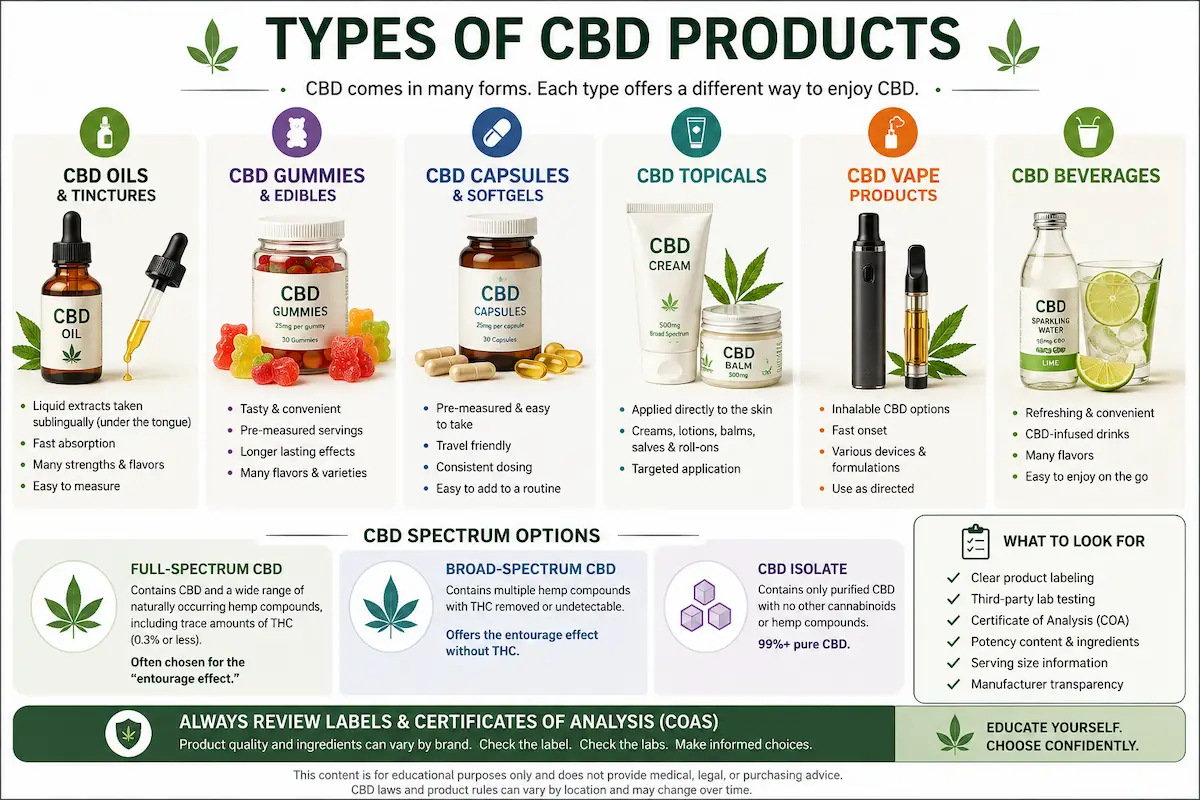
Types of CBD products can seem overwhelming to new consumers because CBD is available in many different forms, including oils, gummies, capsules, topicals, and beverages. While these products all contain cannabidiol (CBD), they differ in how they are packaged, consumed, and presented to consumers.
Understanding the major categories of CBD products can help consumers make more informed decisions when comparing products. Equally important is understanding how to read product labels, review third-party laboratory reports, and recognize common product classifications such as full-spectrum CBD, broad-spectrum CBD, and CBD isolate.
If you’re new to CBD, consider starting with our CBD 101 Basics Guide:
https://hempjuana.com/cbd-101-basics-guide/
This article serves as Part 3 of HempJuana’s CBD Explained Series and focuses on the different types of CBD products available in today’s marketplace.
Table of Contents
CBD Explained Series Navigation
CBD 101 Basics Guide
↓
Part 1: What Is CBD and How Is It Different from THC?
https://hempjuana.com/what-is-cbd-vs-thc/
↓
Part 2: How CBD Is Made From Plant to Product
https://hempjuana.com/how-cbd-is-made-from-plant-to-product/
↓
Part 3: Types of CBD Products (Current Article)
↓
Part 4: How CBD Interacts With the Body
https://hempjuana.com/how-cbd-interacts-with-the-body/
↓
Part 5: The Legal Side of CBD
https://hempjuana.com/legal-side-of-cbd/
What Are CBD Products?
CBD products are consumer products that contain cannabidiol (CBD), one of the many naturally occurring compounds found in cannabis plants.
Most CBD products sold in the United States are derived from hemp. Under federal law, hemp is defined as cannabis containing no more than 0.3% delta-9 THC on a dry-weight basis.
Although CBD products are widely available throughout the marketplace, consumers should understand that the U.S. Food and Drug Administration (FDA) has not approved most CBD products as foods, dietary supplements, or medical treatments. Regulatory requirements continue to evolve, and product rules may vary by state.
If you’re unfamiliar with the differences between CBD and THC, our previous article, What Is CBD and How Is It Different From THC?, provides a beginner-friendly overview.
https://hempjuana.com/what-is-cbd-vs-thc/
CBD can be incorporated into many different product formats. These formats do not indicate effectiveness or quality. Instead, they describe how the CBD is packaged, delivered, or consumed.
Common CBD product categories include:
- CBD oils
- CBD tinctures
- CBD gummies
- CBD capsules
- CBD softgels
- CBD topicals
- CBD vape products
- CBD beverages
As the marketplace continues to evolve, new product categories regularly appear alongside more traditional offerings.
CBD Oils and Tinctures
CBD oils and tinctures remain among the most recognizable products within the CBD marketplace.
These products are commonly sold in small bottles that include a dropper. Labels often display:
- Total CBD content
- CBD per serving
- Ingredient lists
- Serving size information
- Product spectrum classification
Consumers comparing CBD oils may notice significant differences in formulation. Some products use hemp seed oil, MCT oil, or other carrier oils. Others may contain flavoring ingredients or botanical extracts.
Because labels can vary considerably between manufacturers, consumers should review product information carefully rather than assuming products are identical.
Many companies also provide laboratory testing reports that help verify cannabinoid content and other product information.
For readers interested in how hemp is processed into consumer products, see:
How CBD Is Made From Plant to Product
https://hempjuana.com/how-cbd-is-made-from-plant-to-product/
CBD Gummies and Other Edibles
CBD gummies have become one of the most recognizable CBD product categories.
Edible CBD products may include:
- Gummies
- Chews
- Candies
- Chocolates
- Beverage additives
- Specialty snacks
One reason gummies remain popular is convenience. Most products provide a pre-measured amount of CBD per serving, making labels relatively easy to understand.
Consumers reviewing edible products often compare:
- CBD content per serving
- Total CBD per package
- Ingredient lists
- Flavor options
- Serving information
As with other CBD products, ingredients and formulations can vary significantly between manufacturers.
Because edible products may contain numerous additional ingredients, reviewing the ingredient panel can provide useful information when comparing products.
CBD Capsules and Softgels
CBD capsules and softgels offer a format that many consumers already recognize from vitamins and supplements.
Each capsule or softgel typically contains a pre-measured amount of CBD, allowing manufacturers to provide consistent serving information.
Consumers often choose capsules and softgels because they offer:
- Travel convenience
- Consistent serving sizes
- Familiar packaging
- Easy storage
Labels generally include:
- CBD content
- Serving information
- Ingredient lists
- Manufacturer details
As with all CBD products, consumers should review available testing information whenever possible.
CBD Topicals
CBD topicals are products designed for external application.
Common examples include:
- Creams
- Lotions
- Balms
- Salves
- Roll-ons
Unlike gummies, capsules, or oils, topical products are applied directly to the skin.
Consumers comparing topical products may review:
- CBD content
- Product size
- Ingredient lists
- Application instructions
- Additional botanical ingredients
Many topical formulations contain ingredients beyond CBD, which makes reviewing the full ingredient panel an important step when evaluating products.
CBD Vape Products
CBD vape products represent another segment of the CBD marketplace.
Common examples include:
- Disposable vape devices
- Vape cartridges
- CBD vape liquids
Product labels often include:
- CBD concentration
- Product ingredients
- Device compatibility information
- Product classification details
Consumers should review available product information carefully because formulations and manufacturing practices may vary significantly among manufacturers.
This article does not recommend or promote any particular product format. Instead, it focuses on helping readers understand the categories commonly found within the marketplace.
CBD Beverages
CBD beverages are an emerging category within the hemp industry.
Examples include:
- Sparkling beverages
- CBD-infused waters
- Ready-to-drink products
- Specialty beverage formulations
As manufacturers continue exploring new delivery formats, beverage options have expanded significantly over the past several years.
Consumers reviewing beverages may compare:
- CBD content
- Ingredient lists
- Serving sizes
- Product transparency information
As with all CBD products, label review remains an important part of understanding what a product contains.
Comparing Common Types of CBD Products
Different CBD products appeal to different consumer preferences.
Convenience
Some consumers prefer ready-to-use products such as gummies or capsules, while others may prefer liquid products that allow greater flexibility.
Portability
Portable formats such as gummies, capsules, and softgels are often easy to transport and store.
Label Transparency
Transparency can vary significantly throughout the marketplace. Some manufacturers provide detailed product information, while others provide only basic labeling.
Consumer Preferences
Product selection often comes down to personal preferences regarding:
- Packaging
- Serving format
- Ingredients
- Product size
- Available testing documentation
No single CBD product type is universally preferred.
Understanding Full-Spectrum, Broad-Spectrum, and CBD Isolate
In addition to product format, consumers frequently encounter three common CBD classifications.
Understanding these terms can help make product labels easier to interpret.
Full-Spectrum CBD
Full-spectrum CBD products contain CBD along with additional compounds naturally present in hemp.
These products may contain legally compliant levels of THC consistent with federal hemp definitions and applicable regulations.
Because formulations vary, consumers should review product-specific laboratory reports for details regarding cannabinoid content.
Broad-Spectrum CBD
Broad-spectrum CBD products generally contain CBD and additional hemp-derived compounds while undergoing processing intended to remove THC.
Because manufacturing practices differ, consumers should avoid making assumptions based solely on marketing language.
Reviewing a Certificate of Analysis can often provide a clearer picture of a product’s cannabinoid profile.
CBD Isolate
CBD isolate refers to highly purified cannabidiol that has been separated from most other hemp-derived compounds.
Products containing CBD isolate focus primarily on cannabidiol as the principal cannabinoid ingredient.
As with all CBD classifications, product composition should be verified using available laboratory documentation.
How to Read a CBD Product Label
Understanding CBD labels can help consumers better evaluate available products.
CBD Content
Labels commonly display:
- Total CBD per package
- CBD per serving
- Product concentration
Consumers should distinguish between total CBD content and serving-level CBD content.
Serving Size
Serving information helps explain how manufacturers define a serving.
This information can help consumers better understand the amount of product associated with the listed CBD content.
Ingredient Lists
Ingredient lists identify substances included in the product.
Reviewing ingredients may help consumers better understand product composition and compare products more effectively.
Third-Party Testing
Many CBD companies use independent laboratories to test products.
Testing may include:
- Cannabinoid content
- Product consistency
- Certain contaminant screenings
The scope of testing can vary among manufacturers and laboratories.
Certificate of Analysis (COA)
A Certificate of Analysis (COA) is a laboratory report associated with a specific product batch.
Consumers often review COAs to verify:
- Cannabinoid profiles
- Laboratory identification
- Testing dates
- Batch information
Many companies make COAs available through QR codes, website links, or customer support channels.
COAs have become one of the most important transparency tools within the CBD marketplace.
What to Consider Before Purchasing CBD Products
CBD products vary significantly throughout the marketplace.
Consumers commonly review:
- Label transparency
- Ingredient disclosures
- Third-party testing availability
- COA access
- Manufacturer transparency
Research examining CBD product labeling has documented marketplace inconsistencies, highlighting the importance of reviewing available product information carefully.
Consumers may also find it useful to review information from the U.S. Food and Drug Administration regarding cannabis-derived products:
https://www.fda.gov/news-events/public-health-focus/fda-regulation-cannabis-and-cannabis-derived-products-including-cannabidiol-cbd
Additional educational information regarding cannabinoids is available from the National Center for Complementary and Integrative Health:
https://www.nccih.nih.gov/health/cannabis-marijuana-and-cannabinoids-what-you-need-to-know
Information regarding federal hemp regulation can be found through the USDA Domestic Hemp Program:
https://www.ams.usda.gov/rules-regulations/hemp
Research discussing CBD labeling accuracy is also available:
https://www.frontiersin.org/journals/pharmacology/articles/10.3389/fphar.2024.1335441/full
Frequently Asked Questions
What are the main types of CBD products?
Common CBD product categories include oils, tinctures, gummies, capsules, softgels, topicals, vape products, and beverages.
What is the difference between full-spectrum and broad-spectrum CBD?
Full-spectrum products may contain multiple hemp-derived compounds, including legally compliant THC. Broad-spectrum products are generally processed to remove THC while retaining additional hemp-derived compounds.
What is CBD isolate?
CBD isolate is a highly purified form of cannabidiol that has been separated from most other hemp-derived compounds.
What is a CBD Certificate of Analysis?
A Certificate of Analysis (COA) is a laboratory report that provides testing information regarding a specific product batch.
Why should I read a CBD label?
CBD labels provide information regarding ingredients, CBD content, serving sizes, and testing disclosures that may help consumers better understand a product.
Are all CBD products tested by third-party laboratories?
Testing practices vary among manufacturers. Consumers should review available laboratory reports and product information whenever possible.
Conclusion
The modern CBD marketplace offers a wide variety of product formats, including oils, gummies, capsules, softgels, topicals, beverages, and vape products. Understanding these categories can help consumers better navigate product labels and compare available information.
In addition to product format, understanding full-spectrum CBD, broad-spectrum CBD, and CBD isolate classifications can provide useful context when evaluating product labels and laboratory reports.
By understanding product categories, labels, and testing information, consumers can better evaluate the growing variety of CBD products available today.
Readers interested in regulations and compliance considerations can continue to:
As consumers continue learning about CBD, the next step in this series explores how CBD interacts with the body:
Educational Disclaimer
This article is for educational purposes only and does not provide medical, legal, or purchasing advice. CBD laws and product regulations can vary by location and may change over time. Consumers should review product labels, available laboratory reports, and applicable laws before purchasing CBD products.
Article Updated: June 2026
Version: 2.0
Verification Standard: Ground Zero Reverified
Status: Approved for Publication
Editorial Note: This article is provided for informational and educational purposes only. It is based on publicly available regulatory, scientific, and industry sources available at the time of publication. It should not be considered medical, legal, financial, or professional advice. Readers should conduct their own research and consult qualified professionals when making decisions related to CBD products, regulations, or personal circumstances.