
Understanding How CBD Interacts With the Body
Executive Summary
CBD, short for cannabidiol, is one of the the many naturally occurring compounds found in the cannabis plant. Unlike THC, CBD is not generally associated with the intoxicating effects commonly linked to marijuana.
Researchers continue studying how CBD may interact with various signaling systems in the human body, including the endocannabinoid system (ECS). Scientific interest in cannabinoids has expanded significantly in recent years, but many biological mechanisms remain under investigation.
This article explains how researchers currently understand CBD interactions, what scientists continue studying, and why cannabinoid science continues evolving.
Table of Contents
What Is CBD?
CBD is a cannabinoid found in hemp and cannabis plants. It is commonly extracted from federally legal hemp varieties that contain low concentrations of THC.
Cannabinoids are chemical compounds researchers believe may interact with signaling systems throughout the body. Scientists continue studying how cannabinoids influence receptors, enzymes, and communication pathways connected to the ECS and other biological systems.
CBD has become one of the most widely discussed cannabinoids because it does not typically produce the same psychoactive effects associated with THC.
Public interest in CBD expanded rapidly after hemp legalization increased the availability of hemp-derived products throughout the United States. At the same time, researchers began increasing scientific investigation into cannabinoids and their potential interactions with the human body.
For a broader beginner overview, readers can also explore:
Understanding the Endocannabinoid System
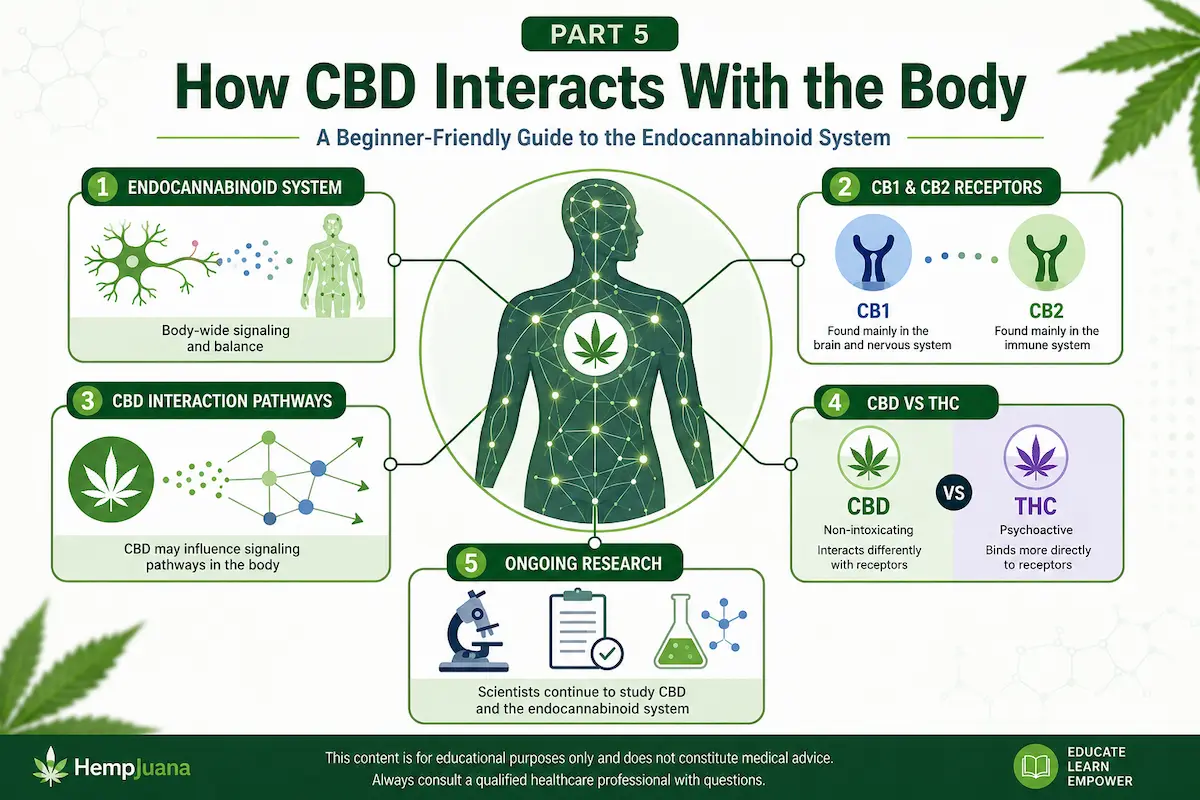
One of the most commonly discussed systems in cannabinoid research is the endocannabinoid system, often called the ECS.
Researchers believe the ECS may help regulate signaling functions throughout the body. The system includes:
- cannabinoid receptors
- naturally occurring signaling molecules called endocannabinoids
- enzymes that help break those compounds down
Scientists continue studying how the ECS may contribute to maintaining internal balance, sometimes referred to as homeostasis.
The ECS became a major area of scientific interest after researchers discovered that cannabinoids from the cannabis plant appeared to interact with biological signaling systems already present in the body. Over time, researchers identified naturally occurring endocannabinoids that the body itself produces.
Today, scientists continue exploring how the ECS may influence communication pathways connected to:
- the nervous system
- immune responses
- appetite regulation
- stress signaling
- sleep-related processes
However, many mechanisms remain under investigation, and researchers have not reached universal agreement on every proposed function of the ECS.
For additional educational information on cannabinoid science and the endocannabinoid system, readers can review resources available through the National Institutes of Health and the National Center for Complementary and Integrative Health.
CB1 and CB2 Receptors Explained
Two of the most commonly discussed cannabinoid receptors are known as CB1 and CB2 receptors.
Researchers believe CB1 receptors are found more heavily in areas connected to the brain and central nervous system. CB2 receptors are more commonly discussed in relation to immune-system signaling and peripheral tissues.
THC appears to interact more directly with CB1 receptors, which is one reason THC is generally associated with intoxicating effects.
CBD appears to function differently. Researchers believe CBD may influence cannabinoid signaling indirectly rather than strongly binding to CB1 receptors in the same way THC does.
Scientists continue studying how cannabinoids interact with both cannabinoid and non-cannabinoid receptors throughout the body.
Because research is still evolving, simplified explanations found online may sometimes overstate certainty regarding receptor behavior and cannabinoid interactions.
How Researchers Believe CBD May Interact With the ECS
Current evidence suggests CBD may interact with the body differently than THC.
Unlike THC, CBD does not appear to strongly bind directly to CB1 receptors in the same way. Instead, researchers believe CBD may influence cannabinoid signaling indirectly through multiple pathways that continue to be studied.
Some studies suggest CBD may:
- influence receptor activity
- interact with enzyme systems
- affect signaling pathways connected to the ECS
- interact with non-cannabinoid receptors under certain conditions
Researchers also continue investigating how CBD may influence the body’s naturally occurring endocannabinoids and the enzymes connected to those compounds.
However, scientific understanding remains incomplete, and researchers continue evaluating competing theories regarding cannabinoid signaling mechanisms.
Because cannabinoid science is still developing, many simplified explanations may overstate certainty about how CBD works inside the body.
CBD and Other Signaling Systems
In addition to the ECS, researchers are studying whether CBD may interact with other systems throughout the body.
Scientific literature has explored possible relationships involving:
- serotonin-related signaling
- inflammatory pathways
- ion channels
- neurological communication systems
- receptor activity outside the ECS
Some researchers are also studying whether cannabinoids may influence signaling pathways connected to stress responses and sensory perception.
However, many of these interactions remain under investigation, and researchers have not reached universal consensus regarding all proposed mechanisms.
This is one reason educational CBD content should avoid overly definitive biological claims or oversimplified descriptions of cannabinoid activity.
Researchers continue publishing cannabinoid-related studies through scientific databases such as PubMed.
Why Cannabinoid Research Is Complex
Cannabinoid science remains a challenging area of study for several reasons.
First, cannabis contains hundreds of naturally occurring compounds, including cannabinoids, terpenes, and flavonoids. Researchers continue studying how these compounds may interact individually and together.
Second, cannabinoid products can vary significantly depending on:
- plant genetics
- extraction methods
- processing techniques
- cannabinoid concentrations
- product formulations
Researchers must also account for differences between laboratory studies, animal studies, and human research when evaluating cannabinoid data.
Historical legal restrictions created additional challenges for researchers studying cannabis and hemp compounds. As regulations evolved, scientific interest expanded, but many gaps in research still remain today.
This complexity is one reason cannabinoid science continues evolving and why experts often encourage caution when interpreting broad claims about CBD.
How CBD Differs From THC in the Body
CBD and THC are both cannabinoids, but they may affect the body differently.
THC is generally associated with intoxicating effects because it appears to interact more directly with CB1 receptors in the brain. CBD, by contrast, appears to function differently and is not generally considered intoxicating in the same way.
Researchers continue studying how cannabinoids influence the body individually and together.
The legal treatment of CBD and THC may also differ depending on:
- THC concentration
- product classification
- federal regulations
- state laws
Readers looking for a deeper beginner explanation can explore:
Why CBD Research Continues Expanding
Interest in cannabinoid science has grown rapidly over the past decade.
Researchers continue studying CBD because:
- cannabinoid science is still relatively young
- legal restrictions historically limited research access
- the ECS itself remains incompletely understood
- hemp legalization expanded scientific and public interest
- consumers became increasingly interested in hemp-derived products
Universities, healthcare researchers, agricultural scientists, and regulatory agencies continue studying cannabinoids from multiple perspectives.
As research expands, scientific understanding may continue changing over time.
This is why many experts encourage readers to approach cannabinoid information carefully and pay attention to evolving evidence rather than relying on overly simplified claims.
Additional cannabinoid research information can also be found through the National Center for Complementary and Integrative Health cannabinoid research resources.
Different Types of CBD Products and Absorption
CBD products are available in several different forms, and researchers continue studying how product formats may influence absorption and cannabinoid delivery.
Common CBD product types include:
- tinctures and oils
- gummies and edible products
- capsules and softgels
- topical creams and lotions
- beverages and drink additives
Some products are designed for oral consumption, while others are intended for topical application.
Researchers continue studying how factors such as digestion, formulation methods, and ingredient composition may influence how cannabinoids are processed by the body.
Product consistency may also vary significantly between manufacturers. This is one reason many educational resources encourage consumers to review product labeling carefully and look for third-party laboratory testing when available.
Readers interested in product categories can explore:
Why Product Quality Matters
The hemp and CBD industry contains a wide range of manufacturing standards and product formulations.
Researchers, regulators, and consumer advocates continue discussing issues involving:
- labeling accuracy
- cannabinoid consistency
- contamination testing
- extraction standards
- ingredient transparency
Third-party laboratory testing is commonly used throughout the hemp industry to evaluate cannabinoid concentrations and screen for contaminants.
However, testing standards and regulations may vary depending on jurisdiction and product category.
As cannabinoid markets continue evolving, product transparency remains an important topic across the hemp industry.
Consumers can also review current federal consumer guidance through the FDA guidance on CBD products.
Common Misunderstandings About CBD and the Body
“Scientists Fully Understand How CBD Works”
This is inaccurate.
Researchers have identified several possible mechanisms, but many interactions remain under investigation.
“CBD Works the Same for Everyone”
Individual responses may vary depending on:
- product formulation
- cannabinoid concentrations
- individual biology
- usage patterns
“All CBD Products Are Identical”
CBD products vary widely in:
- extraction methods
- cannabinoid profiles
- manufacturing standards
- ingredient quality
“CBD Legality Is Simple Everywhere”
CBD legality can vary depending on:
- federal regulations
- state laws
- THC concentration limits
- product classifications
Readers can learn more here:
How CBD Products Are Made
The way CBD is extracted and processed may influence final product composition.
Researchers and manufacturers continue studying extraction methods, cannabinoid preservation, and product consistency across the hemp industry.
Different extraction methods may produce different cannabinoid and terpene profiles, depending on processing techniques and refinement methods.
Readers interested in manufacturing and processing can explore:
Frequently Asked Questions
Is CBD the Same as THC?
No. CBD and THC are different cannabinoids that may interact with the body differently. THC is generally associated with intoxicating effects, while CBD is not commonly described the same way.
Does CBD Affect Everyone the Same Way?
Researchers continue studying how cannabinoids interact with individual biology. Product composition, formulation, and personal factors may influence individual experiences.
Why Are Researchers Interested in the ECS?
Scientists believe the ECS may play a role in signaling processes throughout the body. However, many ECS-related mechanisms remain under investigation.
Are All CBD Products Manufactured the Same Way?
No. CBD products may vary significantly depending on extraction methods, ingredient sourcing, manufacturing standards, and cannabinoid concentrations.
Is Hemp-Derived CBD Federally Legal?
Federal legality may depend on THC concentration limits and product classification. State laws may also differ.
Clarifications and Educational Notes
CBD science continues evolving, and new research may refine current understanding over time.
Educational CBD content should distinguish between:
- ongoing scientific investigation
- preliminary findings
- established evidence
- marketing claims
Readers should be cautious of content that presents cannabinoid science as completely settled or universally agreed upon.
Conclusion
CBD remains one of the most widely studied cannabinoids in modern hemp and cannabis research. Scientists continue exploring how CBD may interact with the body, particularly through pathways connected to the endocannabinoid system and other signaling networks.
At the same time, many biological mechanisms remain under investigation, and scientific understanding continues evolving.
As cannabinoid research grows, educational resources that prioritize accuracy, uncertainty-aware language, and evidence-conscious explanations may help readers better understand this rapidly developing field.
Related CBD Explained Articles
Version: v0.2
Based on publicly available educational, scientific, and regulatory information current as of May 2026.