
Scope Note:
This issue of hemp law vs local zoning continues to affect how hemp businesses operate across different jurisdictions. It does not advocate for specific zoning outcomes or policy reforms. The goal is to explain how regulatory structures function in practice and why outcomes may differ across jurisdictions.
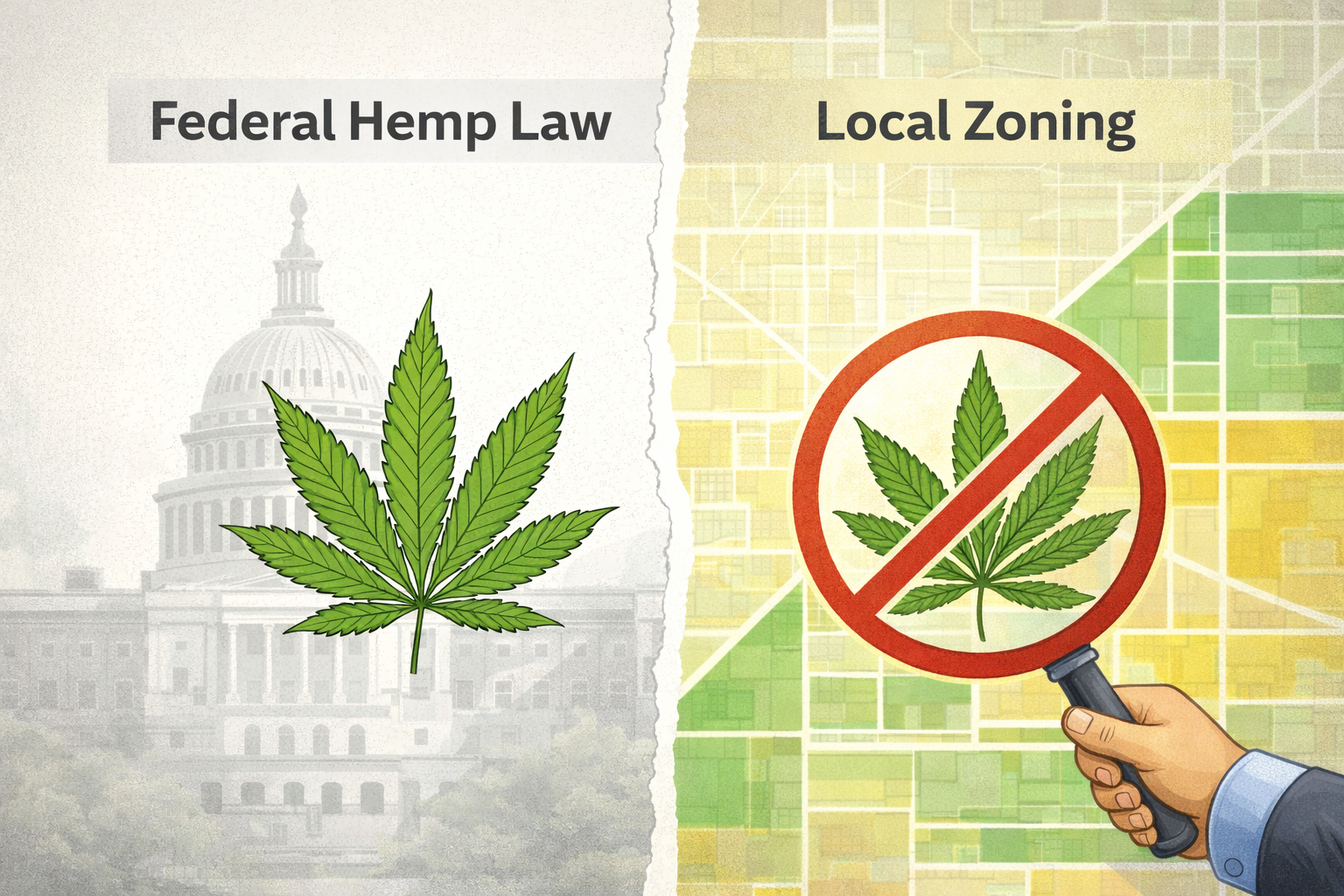
Hemp has been federally legal in the United States since 2018. That legal change was clear and deliberate: hemp was removed from the Controlled Substances Act, defined by a strict THC threshold, and placed under agricultural oversight. From a federal standpoint, hemp is no longer treated as marijuana and is no longer considered an illicit drug.
Yet for many hemp businesses, legalization on paper has not always translated into predictable treatment on the ground.
Across the country, hemp retailers, processors, and manufacturers still encounter zoning restrictions that resemble those applied to marijuana dispensaries or controlled substances. Buffer zones, industrial-only designations, enhanced security requirements, and permit denials continue to appear in local zoning decisions—despite hemp’s legal status.
This gap between federal law and local practice is not rooted in science, and it is not mandated by federal regulation. In most cases, it comes down to how zoning codes define and classify activities.
Hemp Law vs Local Zoning: Where the Disconnect Begins
Zoning codes are not updated automatically when laws change. Many municipal ordinances were written years—sometimes decades—before hemp was legalized. At that time, all cannabis-related activity was illegal under federal law, so zoning language often grouped everything under broad categories such as “marijuana,” “cannabis,” or “controlled substances.”
When federal hemp legalization arrived, most states updated their statutes. Local zoning codes, however, often remained unchanged.
As a result, many municipalities still regulate based on definitions that no longer reflect current law. If hemp is not explicitly defined as a separate legal activity, it is frequently treated as whatever category already exists in the code. In practice, that category is usually marijuana.
This creates a situation where a business selling federally compliant hemp products may be evaluated under zoning rules that were never designed for it.
Administrative Caution, Not Enforcement Intent
It is important to understand that zoning outcomes are usually not driven by hostility or enforcement campaigns. Planning departments are structured to manage risk and apply existing rules consistently. When definitions are unclear, officials often default to the most conservative interpretation available.
From an administrative standpoint, this approach reduces discretion and limits exposure. It is easier to apply a familiar framework than to interpret new industries on a case-by-case basis.
This is why zoning issues related to hemp are often matters of classification rather than enforcement. Businesses are not being cited for illegal activity; they are being evaluated under inherited definitions that do not clearly account for hemp’s legal distinction.
Treating Hemp and Marijuana as the Same Category
One of the most common zoning outcomes for hemp businesses is being placed into the same regulatory category as marijuana operations.
This can include requirements such as:
- Distance buffers from schools or churches
- Industrial zoning restrictions
- Security standards designed for high-THC products
- Odor mitigation rules unrelated to hemp processing
These requirements may be appropriate for certain marijuana activities, but they are often unrelated to the actual risk profile of hemp businesses, especially those focused on non-intoxicating products such as wellness goods or topical formulations.
When zoning codes regulate by category rather than by chemical definition or use, distinctions made at the federal level are effectively lost at the local level.
Why Outcomes Vary So Widely
Because land-use decisions are made locally, zoning treatment for hemp can vary significantly from one jurisdiction to the next. A hemp business that operates without issue in one city may face restrictions or denial in another, even within the same state.
This variability is not necessarily a sign of conflict between governments. It reflects the decentralized nature of zoning authority and the uneven pace at which codes are revised.
Some municipalities have updated their ordinances to explicitly define hemp as a legal agricultural or retail activity. Others continue to rely on legacy language that predates federal legalization.
Who Feels the Impact Most
The effects of zoning inconsistency are not evenly distributed.
Smaller operators—local retailers, farmers pursuing on-site processing, and independent manufacturers—are typically the most affected. These businesses often lack the resources to relocate, seek variances, or navigate prolonged zoning review processes.
Larger entities, by contrast, are more likely to already operate in industrial zones or have access to legal and zoning expertise. Over time, this can create uneven market conditions that are shaped less by federal law and more by local classification practices.
What Federal Law Does Not Do
Federal law does not require hemp businesses to be zoned like marijuana dispensaries. There are no federal mandates for buffer zones, dispensary-style security, or industrial-only zoning for hemp operations.
Land-use authority is intentionally left to states and municipalities. This means zoning outcomes reflect local policy choices and administrative structures, not federal enforcement priorities.
Understanding this distinction is key to understanding why zoning outcomes vary and why federal legalization alone does not resolve local land-use questions.The gap between hemp law vs local zoning is not based on a single rule, but on overlapping regulatory systems.
Clarifications Are Slowly Emerging
Some states have issued guidance clarifying hemp’s legal status for local governments, and courts have occasionally addressed disputes involving hemp classification. These efforts generally focus on definitional clarity rather than the legality of hemp itself.
Progress has been uneven, and many zoning codes still rely on language written before hemp legalization. Updating those codes often requires time, public hearings, and administrative resources, which contributes to the slow pace of change.
Conclusion
Understanding hemp law vs local zoning helps explain why legal hemp businesses still face local restrictions.Hemp’s federal legal status is clear, and the distinction between hemp and marijuana is well established in law. What remains inconsistent is how that distinction is applied within local zoning frameworks.
In many cases, zoning outcomes are shaped by legacy definitions rather than current federal standards. This analysis describes how classification frameworks—rather than enforcement intent—continue to influence how hemp businesses are treated at the local level.
The issue is not enforcement.
It is definition.
Sources:USDA Hemp Program
Agriculture Improvement Act of 2018