
The Federal Baseline
Hemp vs marijuana under federal law describes how federal statutes classify cannabis based on THC content and regulate cultivation differently.
The Controlled Substances Act (CSA), enacted in 1970, classifies marijuana as a Schedule I controlled substance under 21 U.S.C. § 812. Schedule I substances are defined in federal law as drugs with a high potential for abuse and no currently accepted medical use under federal standards. Because marijuana remains listed in Schedule I, federal law prohibits its cultivation, distribution, and possession, except in limited, federally authorized research contexts.
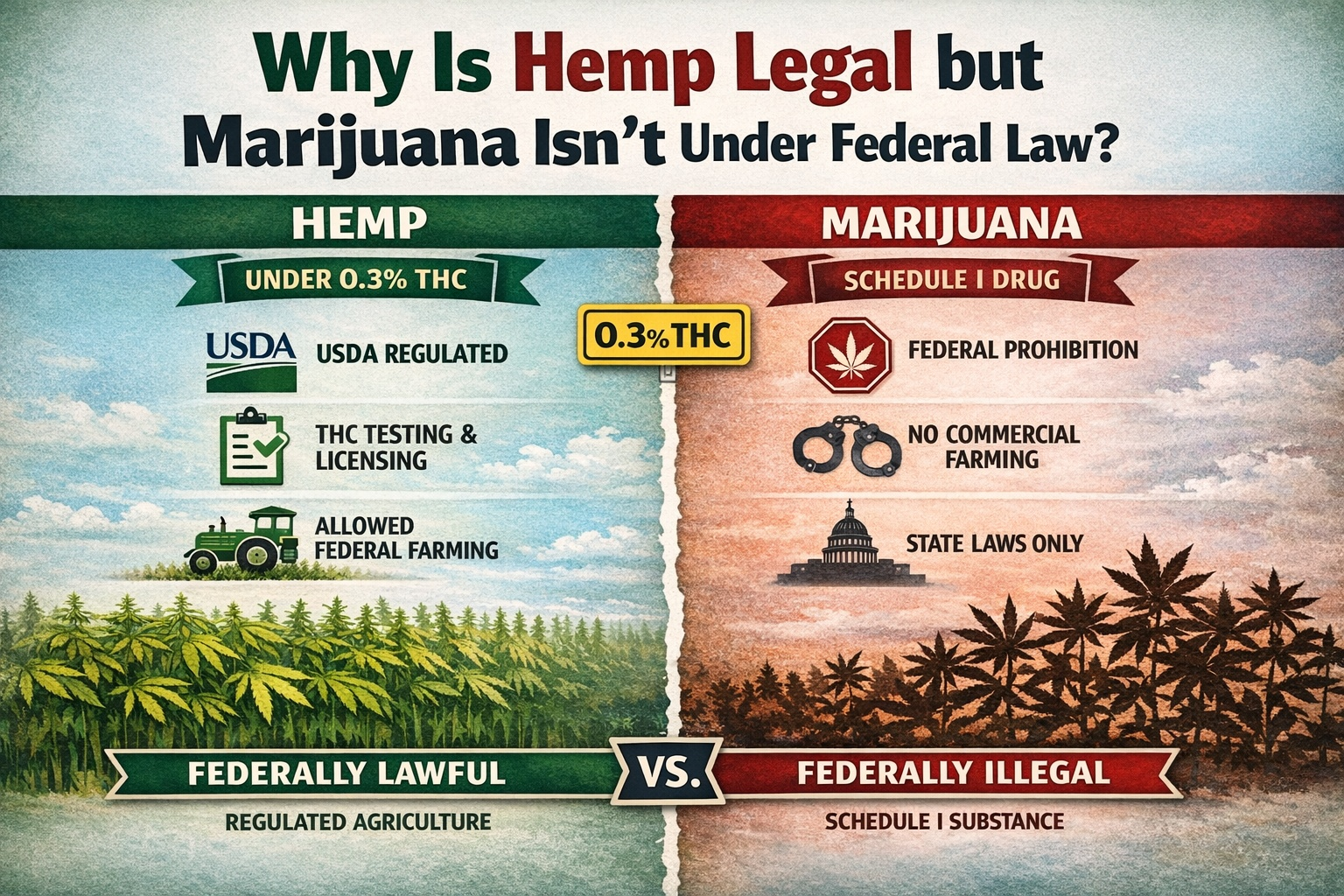
Hemp is treated differently. The Agriculture Improvement Act of 2018 (commonly called the 2018 Farm Bill) removed hemp from the definition of marijuana in the Controlled Substances Act. Under 7 U.S.C. § 1639o, hemp is defined as Cannabis sativa L. and any part of that plant containing not more than 0.3 percent delta-9 tetrahydrocannabinol (THC) on a dry weight basis.
That 0.3 percent THC threshold created a legal dividing line. Above it, the plant is considered marijuana under federal law. At or below it, the plant is considered hemp. This distinction between hemp vs marijuana under federal law is based entirely on statutory definitions, not differences in plant species.
Hemp vs Marijuana Under Federal Law: Why Hemp Farming Is Federally Legal
Because hemp was removed from the Controlled Substances Act, it is no longer treated as a controlled substance at the federal level — provided it meets the 0.3 percent THC threshold.
The 2018 Farm Bill established a federal regulatory framework for hemp production. It authorized the U.S. Department of Agriculture (USDA) to oversee hemp cultivation through approved state or federal plans. These plans include licensing requirements, THC testing, recordkeeping, and procedures for handling crops that exceed the legal THC limit.
The difference between hemp vs marijuana under federal law determines whether cultivation is treated as agriculture or as a controlled activity. In practice, hemp farming operates under agricultural regulation. Farmers grow hemp as a legal crop, but they must comply with federal standards, including THC testing before harvest. If a crop tests above the legal limit, it may be required to be destroyed under regulatory rules.
Why Marijuana Farming Is Still Federally Illegal
Marijuana remains listed in Schedule I under federal law. That means there is no federally authorized commercial cultivation system for marijuana in the same way there is for hemp.
Under federal statute, cultivating marijuana is prohibited except under tightly controlled research programs authorized by federal agencies. There is no federal agricultural licensing framework for commercial marijuana farming.
As a result, from a federal perspective, marijuana cultivation is not recognized as a lawful agricultural activity.
How State Marijuana Programs Operate Alongside Federal Law
Despite federal prohibition, many states have created their own regulatory systems that permit marijuana cultivation under state law.
These state programs typically require growers to obtain state licenses, comply with inspection standards, use tracking systems, and follow testing requirements. Marijuana farming under these programs is legal under state law but remains prohibited under federal statute.
Under the Supremacy Clause of the U.S. Constitution (Article VI), federal law remains the supreme law of the land. State legalization does not override federal classification. Instead, what exists today is a layered system:
- Hemp farming is federally lawful and regulated under agricultural law.
- Marijuana farming may be lawful under state law but remains prohibited under federal law.
This layered structure explains why two different cultivation systems exist for plants that come from the same species.
Why the System Is Split
The split system exists because Congress made two separate legislative decisions at different times.
In 1970, Congress placed marijuana in Schedule I under the Controlled Substances Act.
In 2018, Congress removed hemp — defined by the 0.3 percent THC threshold — from that same statute.
Because marijuana was not removed when hemp was redefined, two separate legal pathways now exist:
- Hemp: Federally lawful if it meets the THC definition and regulatory requirements.
- Marijuana: Federally prohibited unless Congress changes its classification.
The difference between hemp farming and marijuana farming is not primarily about how the plants are grown. It is about how federal law classifies them.
Conclusion
Hemp and marijuana farming operate under different legal systems in the United States because federal law defines and regulates them differently.
Hemp is treated as an agricultural commodity under federal law, subject to regulatory oversight. Marijuana remains classified as a Schedule I controlled substance under federal statute, even if individual states permit its cultivation.
Understanding that distinction helps clarify why the two industries function differently — even though they involve the same plant species.